
A compliance team requires that every AI use case classified as high-risk must complete data validation, bias testing, and business sponsor sign-off as sequential mandatory steps before deployment can proceed. How does watsonx.governance enforce this mandatory sequence?
Select an answer to reveal the explanation.
Short Explanation and Infographic
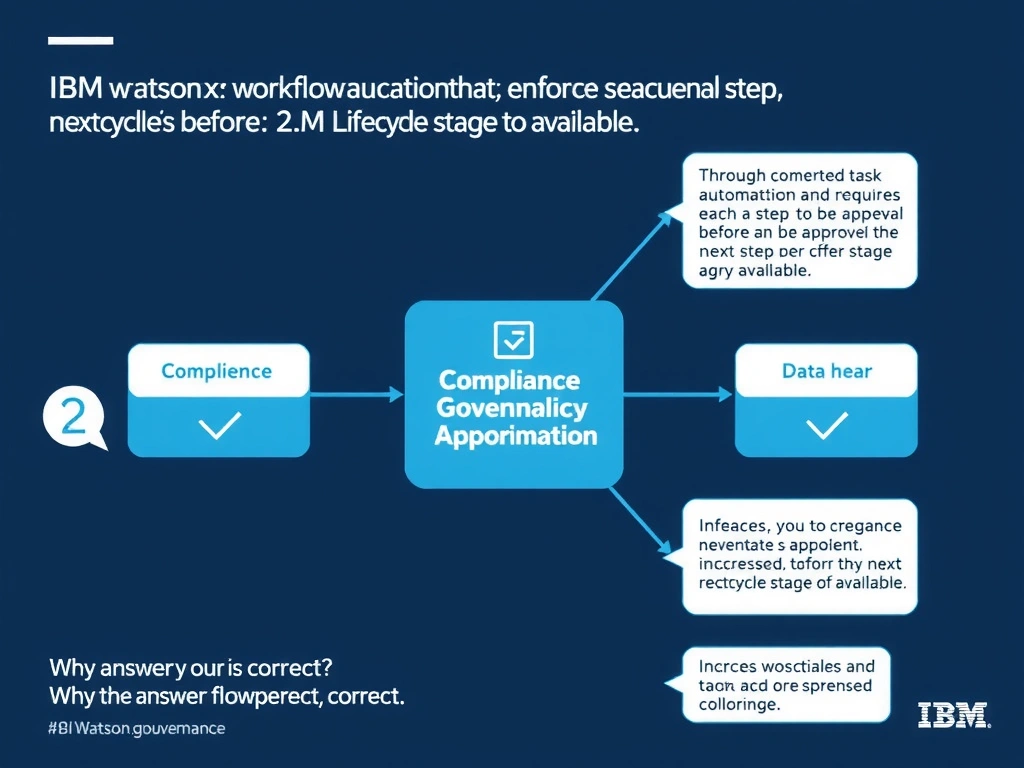
Think of it this way: in real-world AI governance, through compliance workflow automation that enforces sequential task completion and requires each step to be approved before the next step or lifecycle stage becomes available is exactly what teams reach for when they need to handle this scenario. Compliance workflow automation in watsonx. On the exam, remember that this falls squarely under the 2.0 AI Lifecycle Governance domain.
Full explanation below image
Full Explanation
Compliance workflow automation in watsonx.governance enforces sequential, multi-step governance processes by gating lifecycle stage advancement on the completion and approval of all required preceding tasks. When a high-risk use case is submitted for approval, the platform activates the configured workflow which requires each step — data validation review, bias testing sign-off, and business sponsor approval — to be completed in order before the next step becomes available. This enforcement ensures that compliance activities cannot be skipped or reordered, providing a reliable and auditable process even when different teams in different departments are responsible for different steps. The correct answer, "Through compliance workflow automation that enforces sequential task completion and requires each step to be approved before the next step or lifecycle stage becomes available", directly addresses the scenario described because it aligns with the specific governance requirement in question. The incorrect options ("By requiring high-risk model owners to submit a compliance self-attestation form before the Deploy button becomes active in the platform interface", "By generating a risk report that the compliance team reviews offline and then manually updates the use case status to approved in the platform", "By integrating with external project management tools like Jira to create compliance tickets that must be marked complete before deployment is permitted") may seem plausible but do not satisfy the core requirement. Understanding the distinction between these concepts is critical for IBM watsonx.governance implementations and is frequently tested in the 2.0 AI Lifecycle Governance section of the certification exam.