
A New York City employer uses an automated tool that scores résumés and ranks candidates before any human review of job applications. Which watsonx.governance Compliance Accelerator is specifically designed for governance of this type of tool?
Select an answer to reveal the explanation.
Short Explanation and Infographic
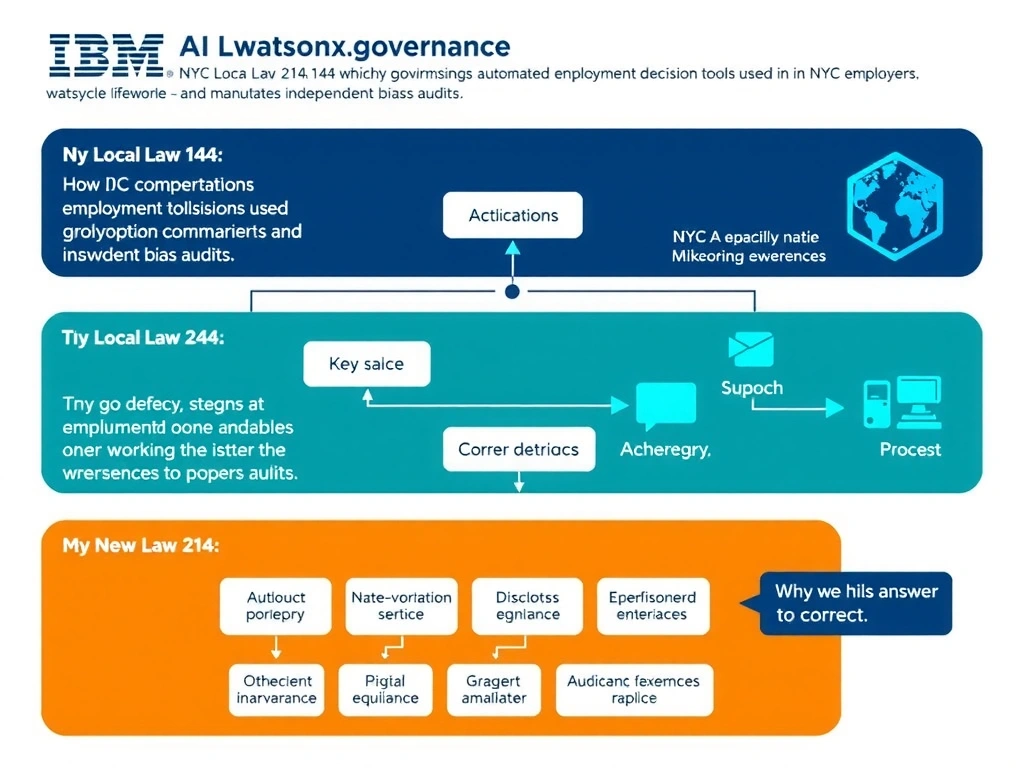
Think of it this way: in real-world AI governance, nyc local law 144 which specifically governs automated employment decision tools used by nyc employers and mandates independent bias audits is exactly what teams reach for when they need to handle this scenario. NYC Local Law 144, effective January 2023, requires employers in New York City that use automated employment decision tools (AEDTs) in hiring or promotion decisions to conduct independent bias audits annually, publish audit summaries publicly, and notify candidates when such tools are used. On the exam, remember that this falls squarely under the 2.0 AI Lifecycle Governance domain.
Full explanation below image
Full Explanation
NYC Local Law 144, effective January 2023, requires employers in New York City that use automated employment decision tools (AEDTs) in hiring or promotion decisions to conduct independent bias audits annually, publish audit summaries publicly, and notify candidates when such tools are used. The NYC Local Law 144 Compliance Accelerator in watsonx.governance provides pre-built requirements, questionnaires, and workflow steps specifically addressing these obligations. Organizations using automated hiring tools in NYC can use this accelerator to systematically document their bias audit results and notification compliance within their centralized AI governance program. The correct answer, "NYC Local Law 144 which specifically governs automated employment decision tools used by NYC employers and mandates independent bias audits", directly addresses the scenario described because it aligns with the specific governance requirement in question. The incorrect options ("EU AI Act because automated hiring tools are classified as high-risk AI systems under Annex III of the regulation", "NIST AI RMF because it provides the most comprehensive US guidance on managing bias risks in algorithmic employment decision systems", "SR 11-7 because it applies to all model risk management practices at regulated employers operating in the United States") may seem plausible but do not satisfy the core requirement. Understanding the distinction between these concepts is critical for IBM watsonx.governance implementations and is frequently tested in the 2.0 AI Lifecycle Governance section of the certification exam.