
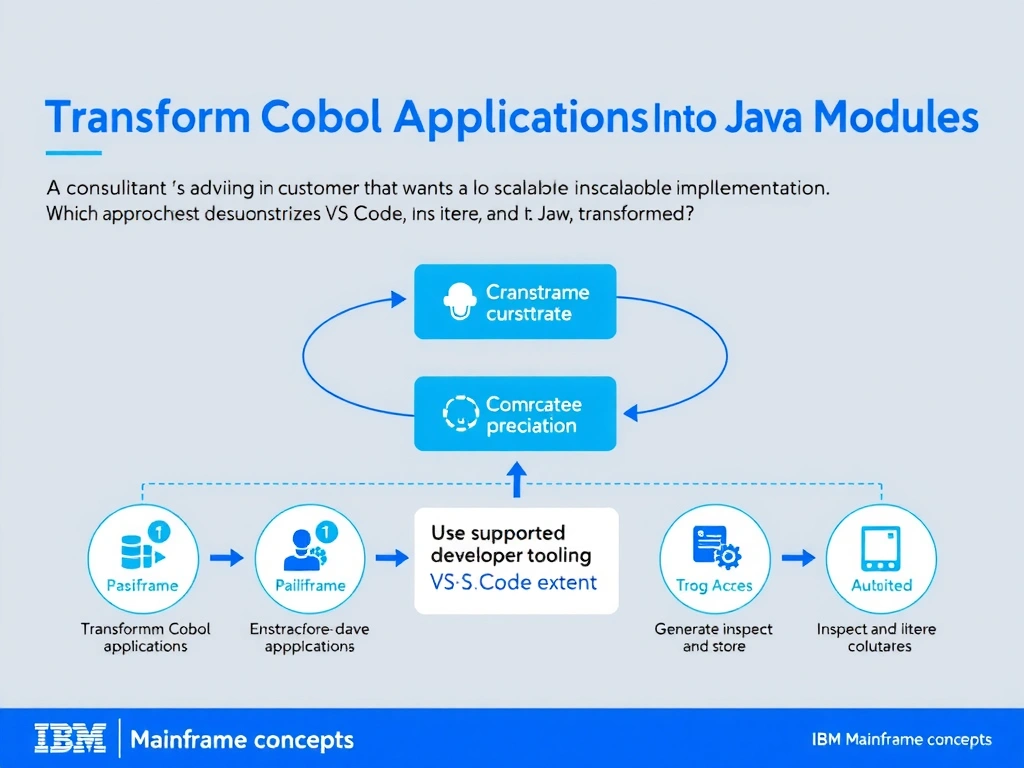
A consultant is advising a customer that wants a scalable implementation. Which approach best demonstrates VS Code extension workflow in a IBM Certified watsonx Mainframe Modernization Architect environment?
Select an answer to reveal the explanation.
Short Explanation and Infographic
Here's the deal: think of VS Code extension workflow like labeling the cables before you close the rack door. If you skip that discipline, troubleshooting gets ugly fast. In this scenario, answer C is the practical move because it keeps the implementation tied to the real IBM capability instead of chasing a shortcut. The other choices sound tempting, but they either skip governance, ignore operational reality, or solve the wrong problem.
Full explanation below image
Full Explanation
Here's the deal: think of VS Code extension workflow like labeling the cables before you close the rack door. If you skip that discipline, troubleshooting gets ugly fast. In this scenario, answer C is the practical move because it keeps the implementation tied to the real IBM capability instead of chasing a shortcut. The other choices sound tempting, but they either skip governance, ignore operational reality, or solve the wrong problem.
The correct answer is C. Use supported developer tooling to generate, inspect, and iterate on transformed code. That aligns with the Domain 6: Transform COBOL Applications into Java Modules objective because it applies the feature or practice in the context where IBM expects a practitioner to use it. It also keeps the design reviewable, supportable, and realistic for a production environment.
Let's examine why the other options are incorrect: - Option A is incorrect because it sounds related, but it does not solve the VS Code extension workflow requirement described in the scenario. - Option B is incorrect because it sounds related, but it does not solve the VS Code extension workflow requirement described in the scenario. - Option D is incorrect because it sounds related, but it does not solve the VS Code extension workflow requirement described in the scenario. For the exam, connect the feature to the operational outcome: the right answer is the one that preserves control, accuracy, and maintainability instead of relying on a brittle shortcut.