
A consultant is advising a customer that wants a scalable implementation. The team is focused on functional requirements. Which recommendation is most appropriate?
Select an answer to reveal the explanation.
Short Explanation and Infographic
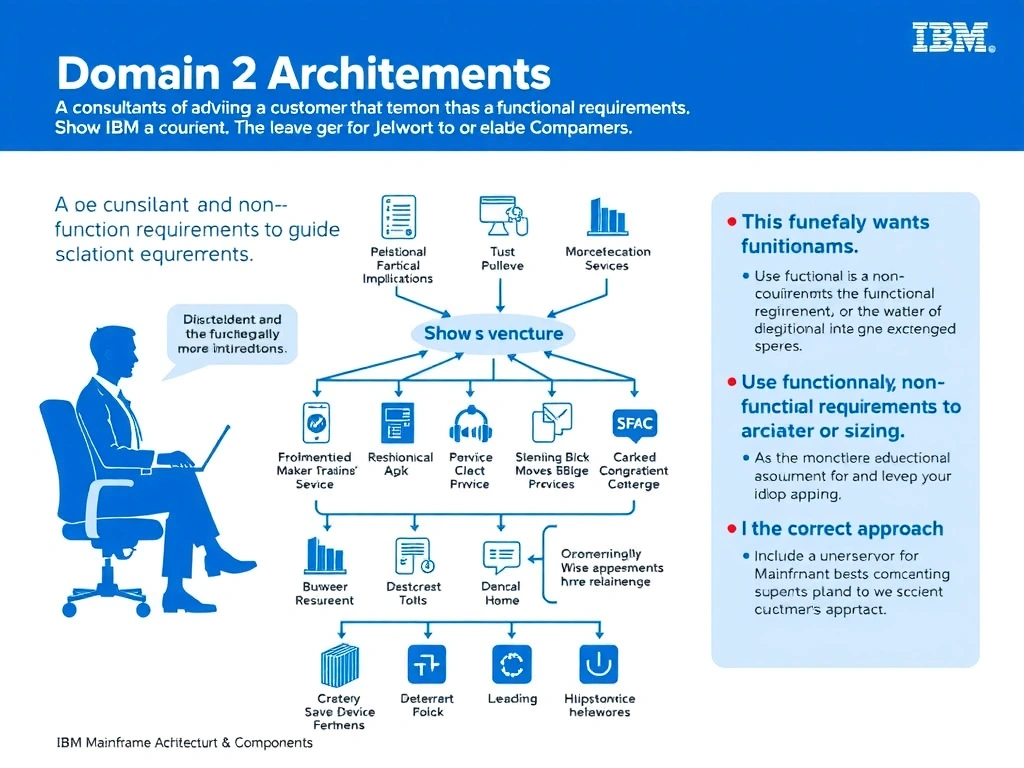
Here's the deal: this is where a demo turns into an operation. The design has to survive real users, real failures, and real audits. In this scenario, answer A is the practical move because it keeps the implementation tied to the real IBM capability instead of chasing a shortcut. The other choices sound tempting, but they either skip governance, ignore operational reality, or solve the wrong problem. The correct answer is A. Use functional and non-functional requirements to guide architecture, sizing, and integration choices. That aligns with the Domain 2: Architecture & Components objective because it applies the feature or practice in the context where IBM expects a practitioner to use it. It also keeps the design reviewable, supportable, and realistic for a production environment.
Full explanation below image
Full Explanation
Here's the deal: this is where a demo turns into an operation. The design has to survive real users, real failures, and real audits. In this scenario, answer A is the practical move because it keeps the implementation tied to the real IBM capability instead of chasing a shortcut. The other choices sound tempting, but they either skip governance, ignore operational reality, or solve the wrong problem.
The correct answer is A. Use functional and non-functional requirements to guide architecture, sizing, and integration choices. That aligns with the Domain 2: Architecture & Components objective because it applies the feature or practice in the context where IBM expects a practitioner to use it. It also keeps the design reviewable, supportable, and realistic for a production environment.
Let's examine why the other options are incorrect: - Option B is incorrect because it narrows the solution to one artifact or metric and misses the broader functional requirements requirement. - Option C is incorrect because it skips the control or validation that makes functional requirements reliable in production. - Option D is incorrect because it uses an overbroad rule instead of matching the design to the actual workload and risk. For the exam, connect the feature to the operational outcome: the right answer is the one that preserves control, accuracy, and maintainability instead of relying on a brittle shortcut.