
During a design review, an architect asks which choice best matches the IBM guidance. The team is focused on service naming rules. Which recommendation is most appropriate?
Select an answer to reveal the explanation.
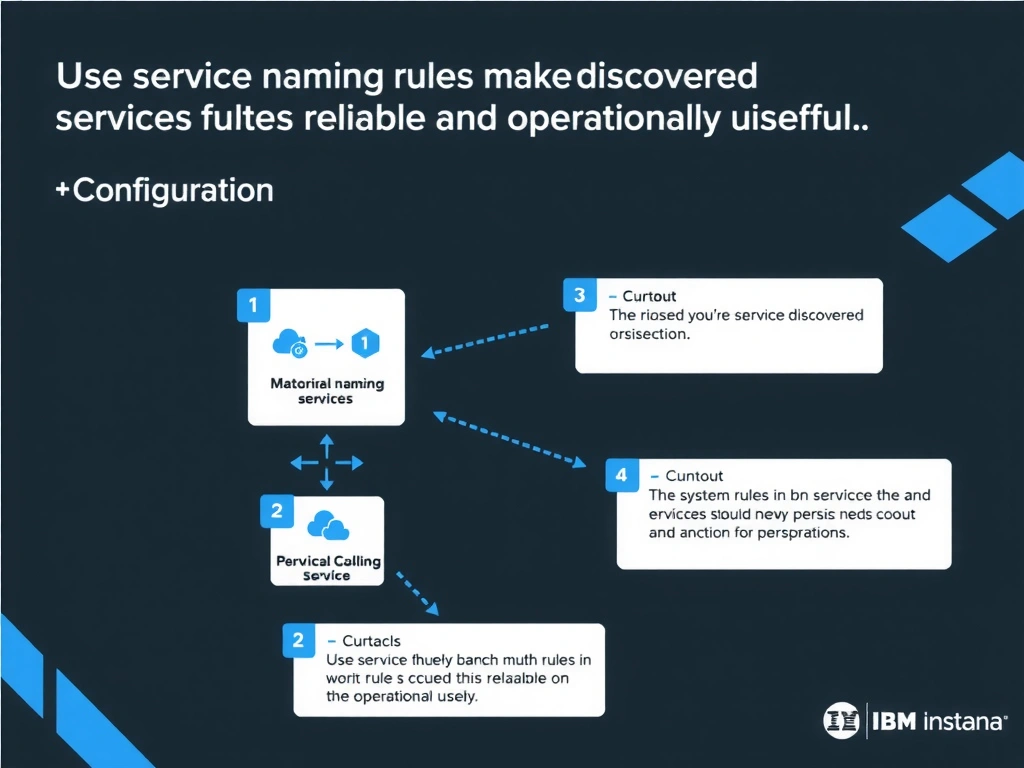
Short Explanation and Infographic
Here's the deal: you would not ship a production change with no owner and no rollback plan. The same common sense applies here. In this scenario, answer B is the practical move because it keeps the implementation tied to the real IBM capability instead of chasing a shortcut.
Full explanation below image
Full Explanation
Here's the deal: you would not ship a production change with no owner and no rollback plan. The same common sense applies here. In this scenario, answer B is the practical move because it keeps the implementation tied to the real IBM capability instead of chasing a shortcut. The other choices sound tempting, but they either skip governance, ignore operational reality, or solve the wrong problem.
The correct answer is B. Use service naming rules to make discovered services readable and operationally useful. That aligns with the Domain 2: Configuration objective because it applies the feature or practice in the context where IBM expects a practitioner to use it. It also keeps the design reviewable, supportable, and realistic for a production environment.
Let's examine why the other options are incorrect: - Option A is incorrect because it narrows the solution to one artifact or metric and misses the broader service naming rules requirement. - Option C is incorrect because it sounds related, but it does not solve the service naming rules requirement described in the scenario. - Option D is incorrect because it uses an overbroad rule instead of matching the design to the actual workload and risk. For the exam, connect the feature to the operational outcome: the right answer is the one that preserves control, accuracy, and maintainability instead of relying on a brittle shortcut. The correct answer is 'Use service naming rules to make discovered services readable and operationally useful.'. The incorrect options — 'Rename services only in screenshots', 'Let random deployment IDs be the permanent service names', 'Use identical names for all services' — are wrong because they do not align with IBM Instana's architecture or recommended practices for this scenario. Understanding this concept is essential for the Domain 2: Configuration domain of the IBM Instana Observability certification.