
During an architecture planning review, a stakeholder questions why ClickHouse is included in the Instana backend stack when Cassandra already handles data storage. What is the primary purpose of ClickHouse in the Instana backend?
Select an answer to reveal the explanation.
Short Explanation and Infographic
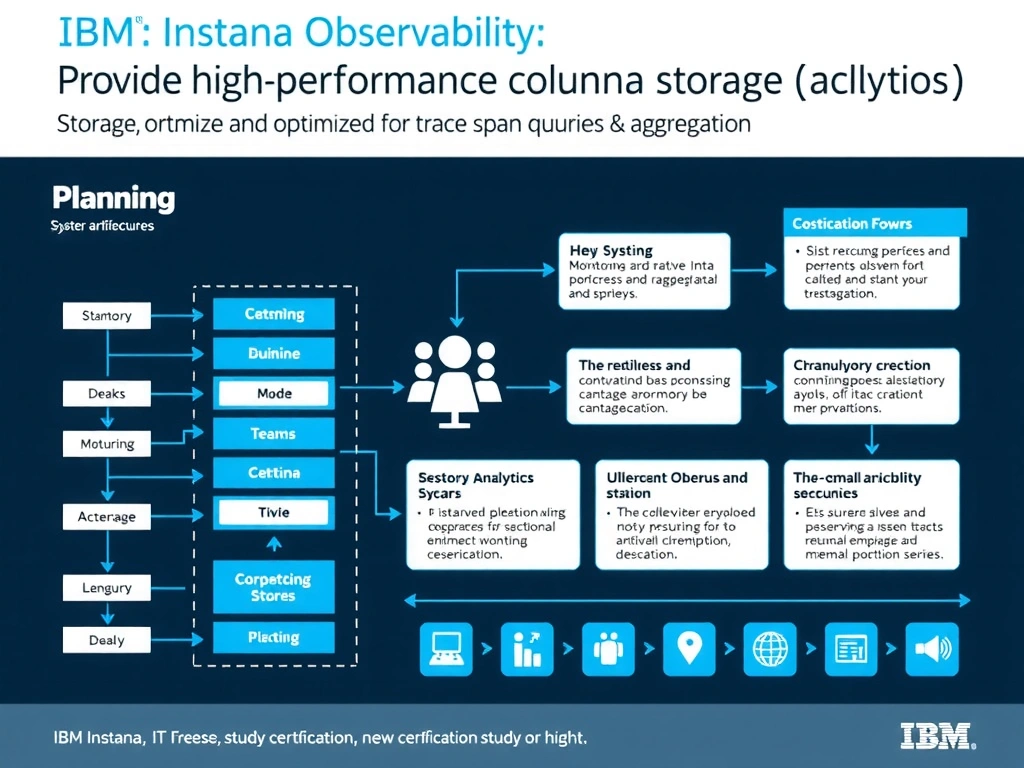
ClickHouse is a columnar database purpose-built for analytical workloads, making it ideal for Instana trace data where users frequently run aggregations, filters, and latency distributions across millions of spans from distributed traces. Its columnar storage format enables significantly faster query performance for trace analytics compared to the row-oriented Cassandra, which is optimized for time-series metrics writes and reads rather than analytical span queries. This division of responsibility between ClickHouse (traces) and Cassandra (metrics) is central to the modern Instana architecture.
Full explanation below image
Full Explanation
ClickHouse is a columnar database purpose-built for analytical workloads, making it ideal for Instana trace data where users frequently run aggregations, filters, and latency distributions across millions of spans from distributed traces. Its columnar storage format enables significantly faster query performance for trace analytics compared to the row-oriented Cassandra, which is optimized for time-series metrics writes and reads rather than analytical span queries. This division of responsibility between ClickHouse (traces) and Cassandra (metrics) is central to the modern Instana architecture. The correct answer is 'Providing high-performance columnar analytics storage optimized for trace span queries and aggregation operations'. The incorrect options — 'Coordinating distributed write transactions across Cassandra nodes to enforce consistency guarantees', 'Acting as a write-through cache between Kafka consumers and Cassandra to reduce write amplification at high ingest rates', 'Storing agent sensor plugin definitions, backend application settings, and Instana configuration state' — are wrong because they do not align with IBM Instana's architecture or recommended practices for this scenario. Understanding this concept is essential for the Domain 5: Planning domain of the IBM Instana Observability certification.