
A financial services company requires high availability for their Instana deployment with no single point of failure. When planning the Elasticsearch cluster for production, what is the minimum number of Elasticsearch nodes required to achieve a quorum-based fault-tolerant configuration?
Select an answer to reveal the explanation.
Short Explanation and Infographic
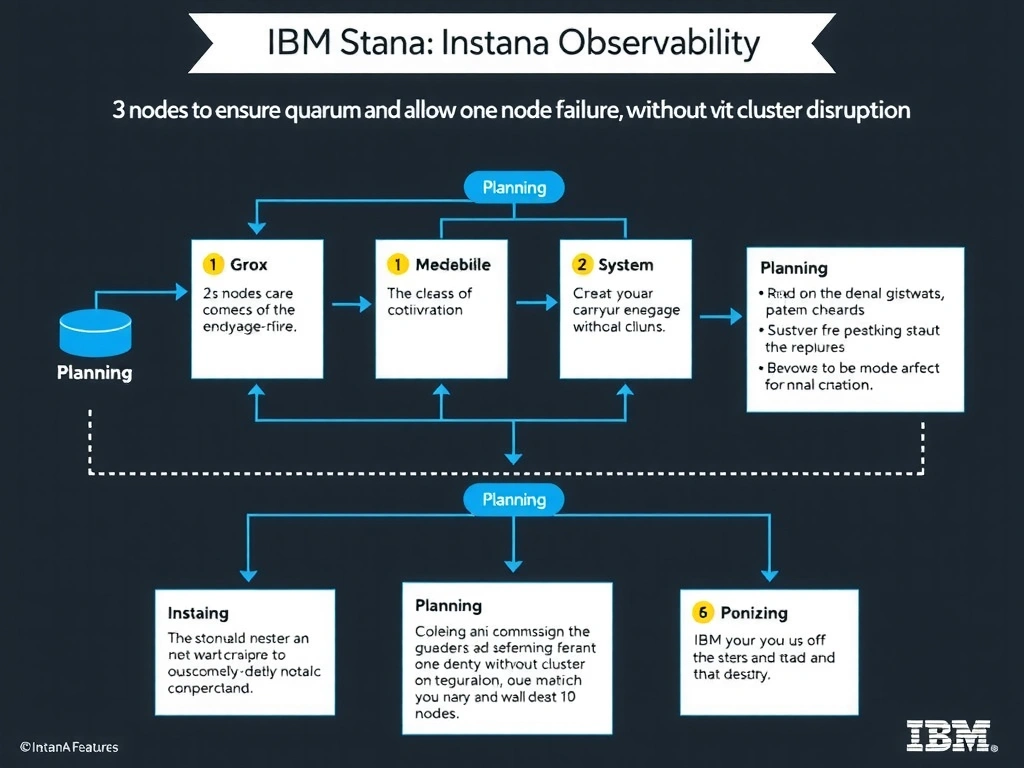
Elasticsearch requires a minimum of 3 nodes in a production HA configuration to support quorum-based master election, allowing the cluster to remain fully operational even if one node fails. A 2-node cluster cannot form a true quorum and is vulnerable to split-brain scenarios, while a single node provides no redundancy. This 3-node minimum applies to the Elasticsearch component Instana uses for the dynamic graph, events, and search indexing.
Full explanation below image
Full Explanation
Elasticsearch requires a minimum of 3 nodes in a production HA configuration to support quorum-based master election, allowing the cluster to remain fully operational even if one node fails. A 2-node cluster cannot form a true quorum and is vulnerable to split-brain scenarios, while a single node provides no redundancy. This 3-node minimum applies to the Elasticsearch component Instana uses for the dynamic graph, events, and search indexing. The correct answer is '3 nodes to ensure quorum and allow one node failure without cluster disruption'. The incorrect options — '1 node with RAID storage for hardware redundancy', '2 nodes in an active-passive failover pair', '6 nodes, since Elasticsearch requires 2x replication minimum for all deployments' — are wrong because they do not align with IBM Instana's architecture or recommended practices for this scenario. Understanding this concept is essential for the Domain 5: Planning domain of the IBM Instana Observability certification.