
During a design review, an architect asks which choice best matches the IBM guidance. What is the best way to handle SQL troubleshooting while staying aligned with the certification objectives?
Select an answer to reveal the explanation.
Short Explanation and Infographic
Here's the deal: a failed SQL query is not a disaster, it's a diagnosis waiting to happen. In IBM watsonx.data, troubleshooting means checking four things in order: syntax (did you write it right?), permissions (are you allowed to run it?), source availability (is the table registered and the engine running?), and engine selection (are you using the right engine for this workload?). Think of it like a doctor's differential diagnosis — you rule things out systematically.
Full explanation below image
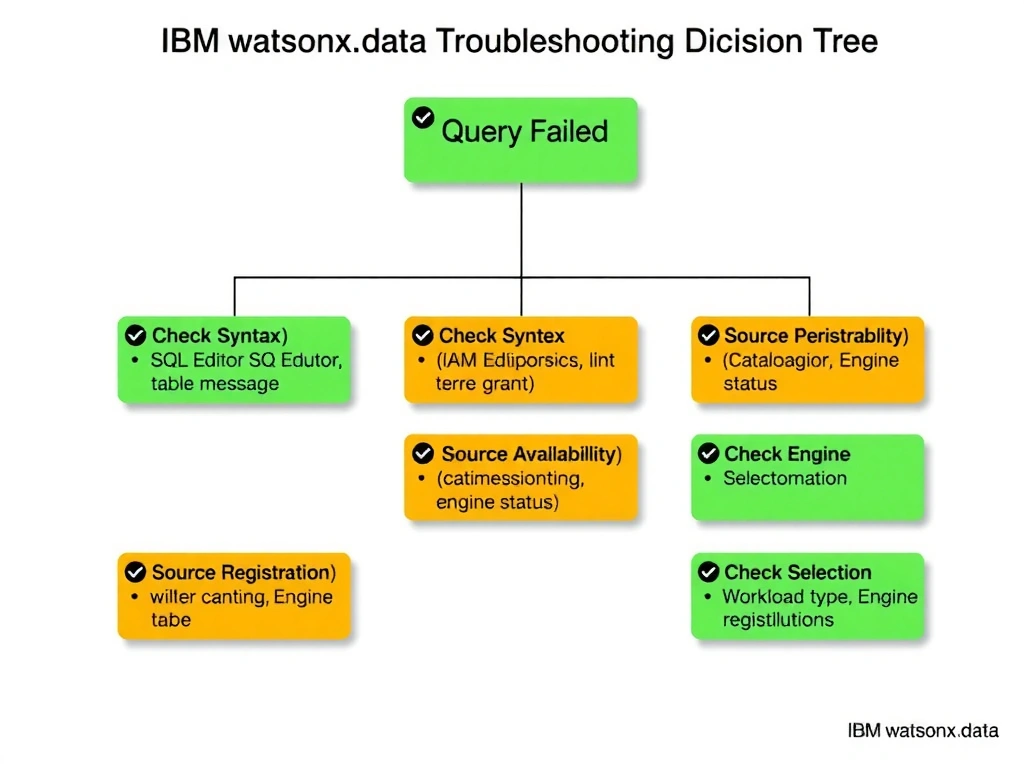
Full Explanation
SQL query failures in IBM watsonx.data typically fall into four root cause categories: syntax errors (invalid SQL, wrong column names, missing clauses), permission errors (the user or role lacks access to the table or schema), source availability issues (the table is not registered in the catalog or the query engine is stopped), and engine selection mismatches (using a Presto engine for a workload that requires Spark, or querying an unregistered external table without the appropriate connector). The correct answer — checking syntax, permissions, source availability, and engine selection — represents the systematic diagnostic approach IBM expects. Assuming every failed query means data loss (Option A) creates unnecessary panic and incorrect incident response; most query failures are operational rather than data integrity issues. Increasing storage capacity before reading the error (Option B) is a classic misdirected fix — storage capacity rarely causes SQL query failures and the error message itself would immediately point to the real cause. Changing dashboard colors to refresh metadata (Option C) has no relationship to SQL execution; metadata refreshes are done through catalog operations, not UI styling changes. The certification expects a structured, evidence-based troubleshooting approach rather than guessing.