
A project lead is turning a proof of concept into a governed production workflow. Which approach best demonstrates predictive vs exploratory analytics in a IBM Certified watsonx Data Lakehouse Engineer environment?
Select an answer to reveal the explanation.
Short Explanation and Infographic
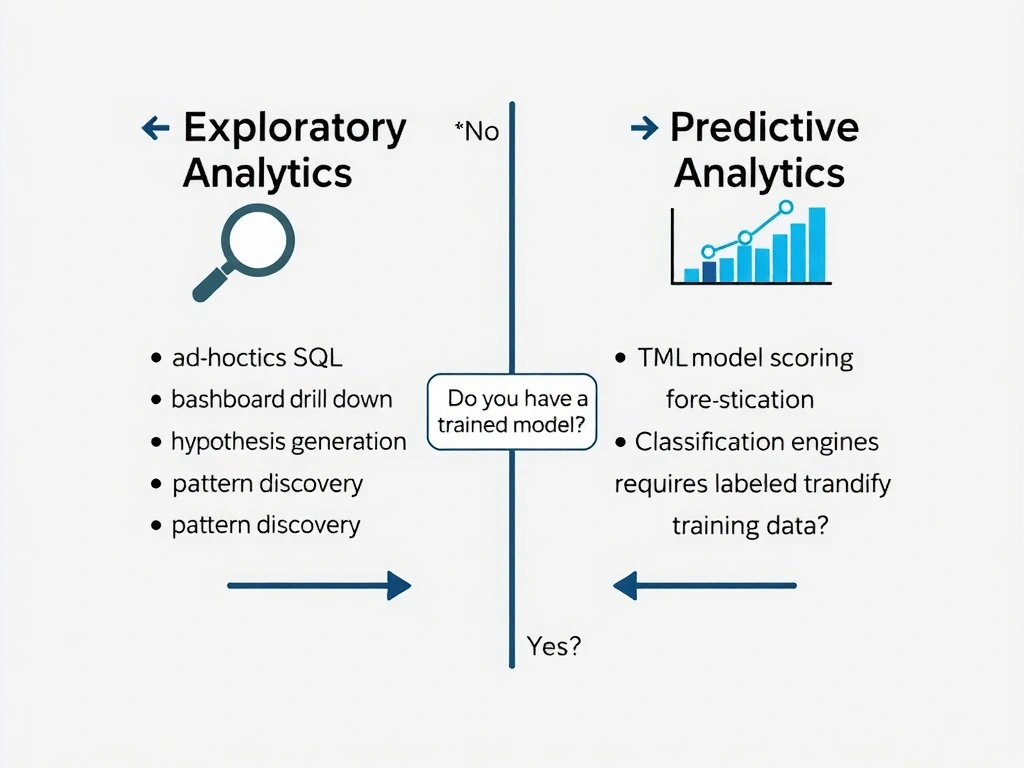
Here's the deal: exploratory analytics is like shining a flashlight around a dark room to see what's there — you don't know what you'll find. Predictive analytics is like installing a security camera to watch specifically for intruders — you know what you're looking for and you've trained the system to recognize it. Both are valuable, but only if you use the right one for the right job. Treating ad hoc filtering as a predictive model is like claiming your flashlight is a security camera.
Full explanation below image
Full Explanation
IBM watsonx.data supports both exploratory and predictive analytics as distinct consumption patterns within the lakehouse architecture. Exploratory analytics — interactive SQL, dashboards, ad hoc queries, and statistical summaries — is used when analysts are discovering patterns, understanding data distributions, and formulating hypotheses without a predefined outcome. Predictive analytics involves trained machine learning models (often built in IBM Watson Studio or watsonx.ai) that score new data to produce forecasts, classifications, or recommendations based on learned patterns from historical data. The correct answer — using exploratory analytics for discovery and predictive analytics for model-driven forecasting or scoring — reflects the clear functional distinction IBM draws between these two consumption modes. Treating ad hoc filtering as a trained predictive model (Option A) confuses SQL WHERE clauses with machine learning inference — filtering based on rules is not the same as statistical prediction from learned weights. Using predictive analytics when no target or history exists (Option C) is impossible — supervised ML models require labeled historical data to train; without it, there is nothing for the model to learn from. Avoiding exploratory work before modeling (Option D) skips the data understanding phase that is essential for feature engineering, identifying data quality issues, and validating that sufficient signal exists before investing in model development. The certification expects candidates to select the appropriate analytics mode based on whether a hypothesis or trained model exists.