
A senior engineer reviews the current plan and notices that one key control is missing. What is the best way to handle cloud object storage while staying aligned with the certification objectives?
Select an answer to reveal the explanation.
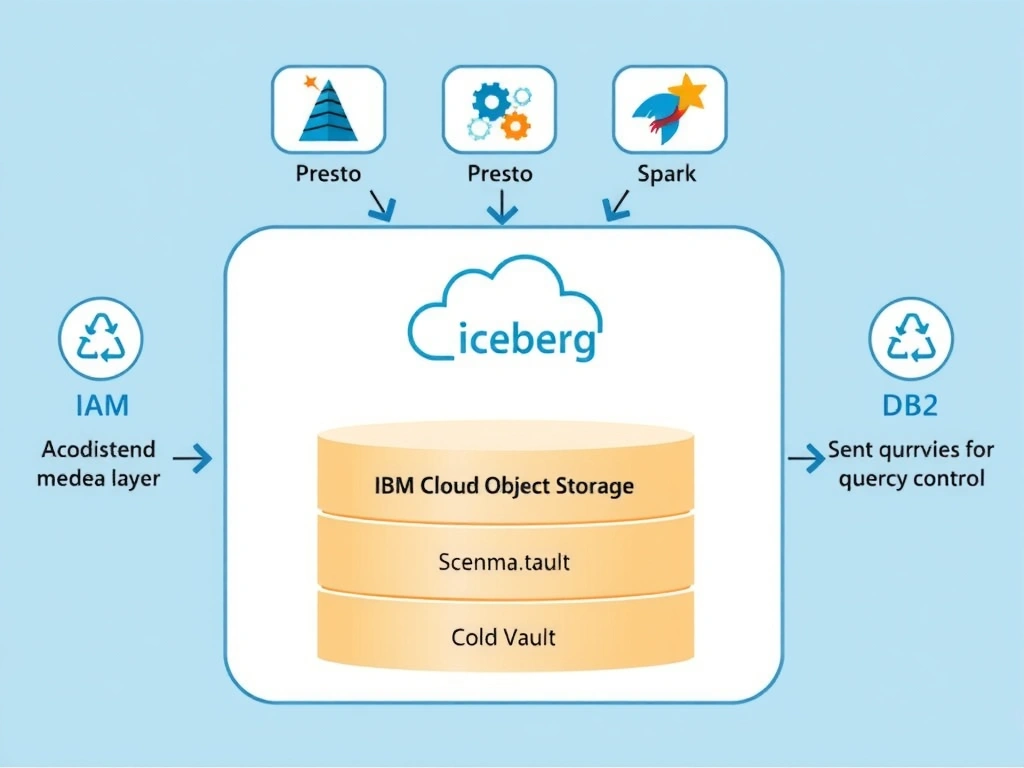
Short Explanation and Infographic
Here's the deal: cloud object storage is the foundation of the lakehouse — it's not a network drive, it's not a filesystem, and you definitely cannot treat it like one. IBM Cloud Object Storage is infinitely scalable, durably redundant (11 nines), and dirt cheap compared to block storage, but it has HTTP semantics, eventual consistency nuances, and requires metadata catalog management on top to make it queryable. Treat it right and it scales to petabytes without breaking a sweat.
Full explanation below image
Full Explanation
IBM watsonx.data uses cloud object storage (IBM Cloud Object Storage or S3-compatible endpoints) as the primary data persistence layer because it provides near-unlimited scalability, geographic redundancy, cost-effective tiered storage classes, and decoupled compute-storage architecture that allows multiple engines to read the same data simultaneously. The correct answer — using object storage as scalable, durable lakehouse storage while managing metadata and access controls — reflects the design reality that object storage alone is not queryable; it requires the Apache Iceberg catalog layer on top to provide table semantics, schema enforcement, and governance. Treating object storage like a local POSIX filesystem (Option A) fails because object storage uses HTTP PUT/GET semantics, not file system calls; tools that expect POSIX behavior (rename, append) will fail or behave incorrectly against S3-compatible endpoints. Avoiding object storage because SQL cannot query it directly (Option B) is factually incorrect — SQL engines query object storage constantly through the Iceberg catalog layer; the catalog translates table references to object paths. Storing credentials in table names (Option C) is a critical security vulnerability that exposes access keys in catalog metadata visible to any user with catalog read access. Object storage is a core architectural component that must be properly governed, not treated as a raw filesystem.