
A project lead is turning a proof of concept into a governed production workflow. What is the best way to handle watsonx.data components while staying aligned with the certification objectives?
Select an answer to reveal the explanation.
Short Explanation and Infographic
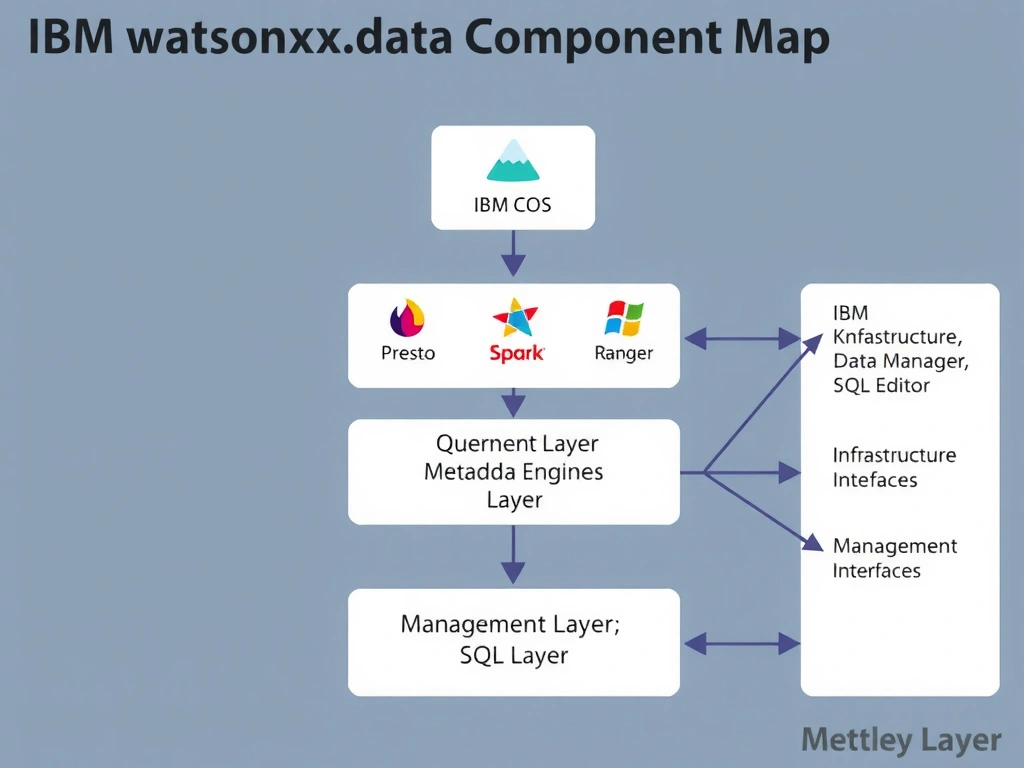
Here's the deal: IBM watsonx.data is not just a query engine and a bucket of files — it's a coordinated platform with five major component categories working in concert. Think of it like an orchestra: the storage is the strings, the metadata catalog is the sheet music, the query engines are the wind and brass sections, governance is the conductor, and the management interfaces are the concert hall itself. You need all of them playing together.
Full explanation below image
Full Explanation
IBM watsonx.data's architecture integrates five primary component categories: object storage (IBM Cloud Object Storage or S3-compatible) for scalable data persistence, the Apache Iceberg metadata catalog for schema and governance metadata, multiple query engines (Presto, Spark, Db2) for workload-specific processing, governance frameworks (IBM Knowledge Catalog, Apache Ranger) for access control and policy enforcement, and management interfaces (Infrastructure Manager, Data Manager, Query Workspace) for operational administration. The correct answer — coordinating all these components as parts of one platform — reflects the integration design philosophy where no single component functions effectively in isolation. Treating the query workspace as the only component (Option A) ignores the storage layer, metadata catalog, and governance stack that make the query workspace functional; the editor cannot query data that isn't registered in a catalog backed by managed storage. Managing access only in external BI tools (Option C) duplicates governance effort and leaves the lakehouse itself ungoverned — BI tool filters are not the same as catalog-level access controls. Putting all metadata in user spreadsheets (Option D) produces untrustworthy, unmaintainable metadata that falls out of sync with the actual table definitions the moment a schema change occurs. The certification requires understanding how the components integrate rather than treating any single interface as the complete platform.