
An administrator is troubleshooting a pilot deployment and wants the most appropriate next step. Which approach best demonstrates multi-engine approach in a IBM Certified watsonx Data Lakehouse Engineer environment?
Select an answer to reveal the explanation.
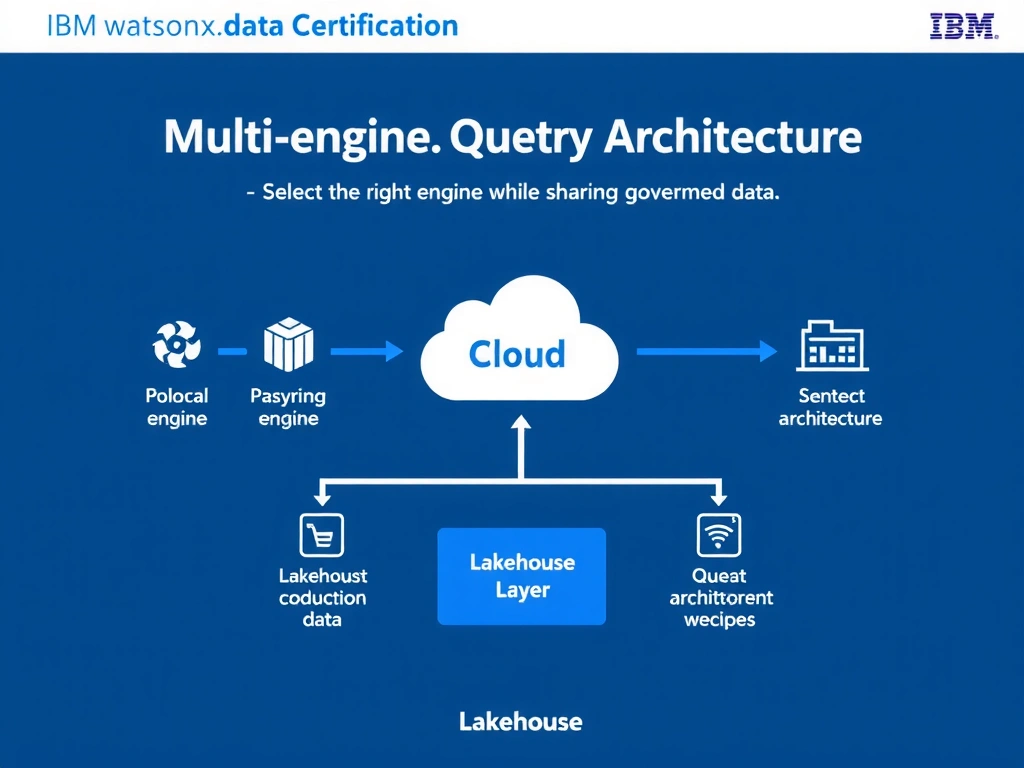
Short Explanation and Infographic
Think of watsonx.data as a tool belt: Presto is your precision screwdriver for interactive analytics, Spark is the power drill for bulk workloads, and the unified governance layer makes sure everyone is working off the same approved dataset. Selecting the right engine per workload keeps performance high and cost controlled while the shared catalog keeps governance intact. Creating isolated copies defeats the entire lakehouse value proposition.
Full explanation below image
Full Explanation
The correct answer is option A: Select the right engine for the workload while sharing governed data through the lakehouse.. This aligns with IBM's IBM watsonx.data platform architecture guidance, which emphasizes select the right engine for the workload while sharing governed data through the lakehouse as the recommended approach for production deployments. Option B (Create isolated copies for every engine) is incorrect because it either bypasses IBM's recommended architecture or introduces operational risk that the correct approach is specifically designed to avoid. Option C (Use one engine for every workload regardless of fit) is incorrect because it either bypasses IBM's recommended architecture or introduces operational risk that the correct approach is specifically designed to avoid. Option D (Bypass governance when switching engines) is incorrect because it either bypasses IBM's recommended architecture or introduces operational risk that the correct approach is specifically designed to avoid. Understanding this distinction is critical for the C9007300 exam: IBM watsonx.data is designed to enforce governance, performance, and operational best practices through its built-in architecture, and the correct answers consistently reflect those architectural constraints rather than shortcut alternatives.