
A senior engineer reviews the current plan and notices that one key control is missing. For IBM Certified watsonx Data Lakehouse Engineer, the topic is cloud object storage. What should the team do?
Select an answer to reveal the explanation.
Short Explanation and Infographic
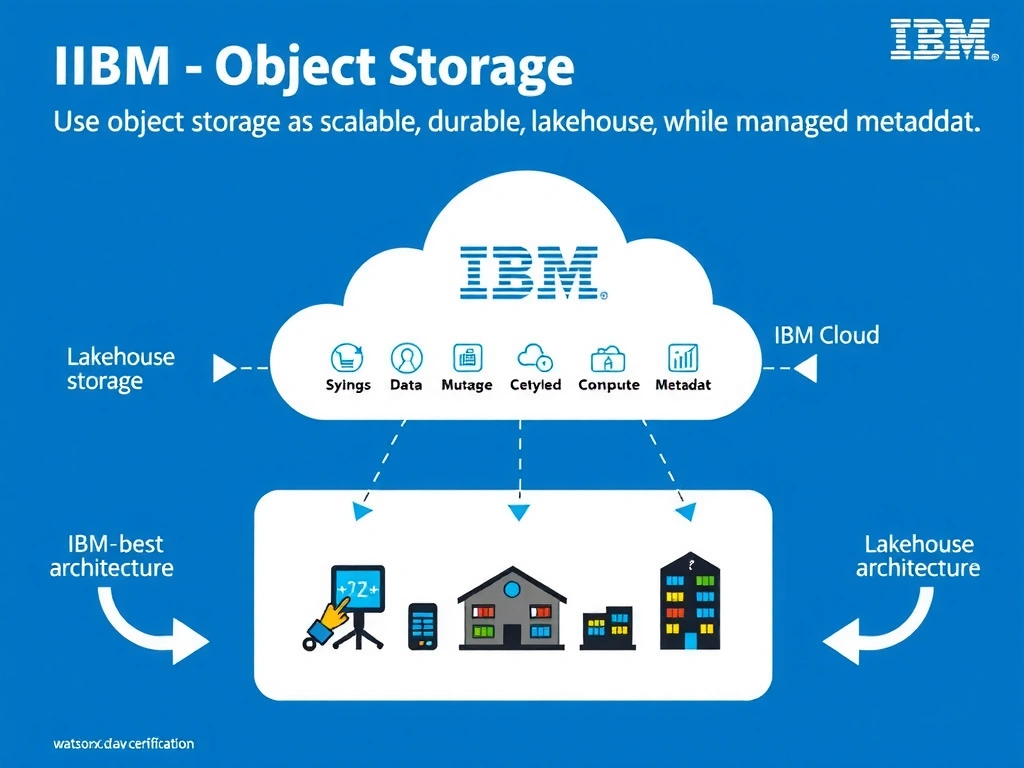
Here's the deal: object storage is the foundation of the lakehouse architecture specifically because it separates compute from storage — you scale storage independently from query engines, pay only for what you store, and every engine (Presto, Spark, Db2) reads the same files without moving or copying data. Traditional data warehouses tie storage to compute, which is exactly the cost and flexibility problem the lakehouse solves. Object storage under open table formats is what makes the economics work.
Full explanation below image
Full Explanation
The correct answer is option D: Use object storage as scalable, durable lakehouse storage while managing metadata and access controls.. This aligns with IBM's Data lakehouse fundamentals guidance, which emphasizes use object storage as scalable, durable lakehouse storage while managing metadata and access controls as the recommended approach for production deployments. Option A (Treat object storage like a local POSIX filesystem) is incorrect because it either bypasses IBM's recommended architecture or introduces operational risk that the correct approach is specifically designed to avoid. Option B (Avoid object storage because SQL cannot query it) is incorrect because it either bypasses IBM's recommended architecture or introduces operational risk that the correct approach is specifically designed to avoid. Option C (Store credentials in table names) is incorrect because it either bypasses IBM's recommended architecture or introduces operational risk that the correct approach is specifically designed to avoid. Understanding this distinction is critical for the C9007300 exam: IBM watsonx.data is designed to enforce governance, performance, and operational best practices through its built-in architecture, and the correct answers consistently reflect those architectural constraints rather than shortcut alternatives.