
During a design review, an architect asks which choice best matches the IBM guidance. The team is focused on ACID table behavior. Which recommendation is most appropriate?
Select an answer to reveal the explanation.
Short Explanation and Infographic
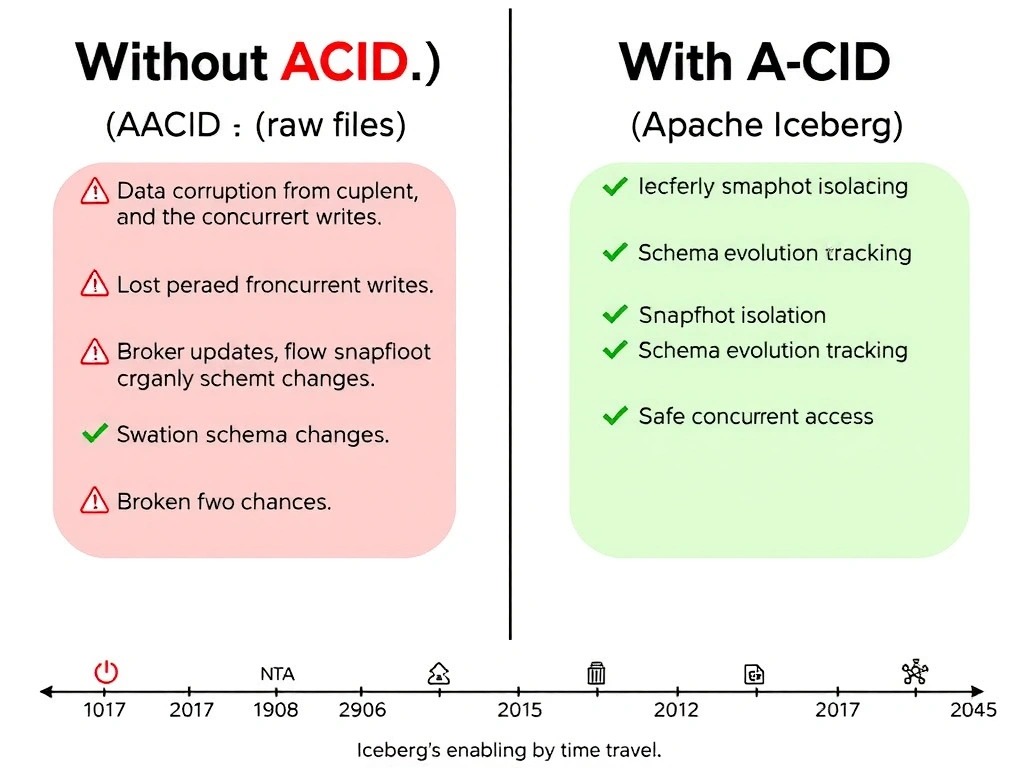
Here's the deal: ACID in a lakehouse context is what separates a professional data platform from a shared network drive full of CSV files. Apache Iceberg (and Delta Lake) give you Atomicity, Consistency, Isolation, and Durability on top of object storage — meaning concurrent writers don't corrupt each other's data, schema changes are safe, and you can time-travel to any previous snapshot. File naming conventions give you none of that.
Full explanation below image
Full Explanation
The correct answer is to use table formats that provide transactional consistency, schema evolution, and reliable concurrent access. Apache Iceberg — the primary open table format in watsonx.data — implements ACID semantics via snapshot isolation, optimistic concurrency control, and manifest-based metadata commits. Option A (file naming conventions) is wrong because naming conventions are a convention, not a transaction manager — two writers can still create conflicting files with no rollback capability. Option C (disabling metadata tracking) is wrong because metadata IS the transaction log in Iceberg; removing it eliminates all ACID guarantees, time travel, and schema evolution. Option D (allowing each engine to rewrite files independently) is wrong because without coordination through the Iceberg catalog, concurrent rewrites cause data corruption and lost updates. ACID compliance in a lakehouse requires a table format that coordinates all reads and writes through a consistent metadata layer.