
A project lead is turning a proof of concept into a governed production workflow. The team is focused on ingestion design. Which recommendation is most appropriate?
Select an answer to reveal the explanation.
Short Explanation and Infographic
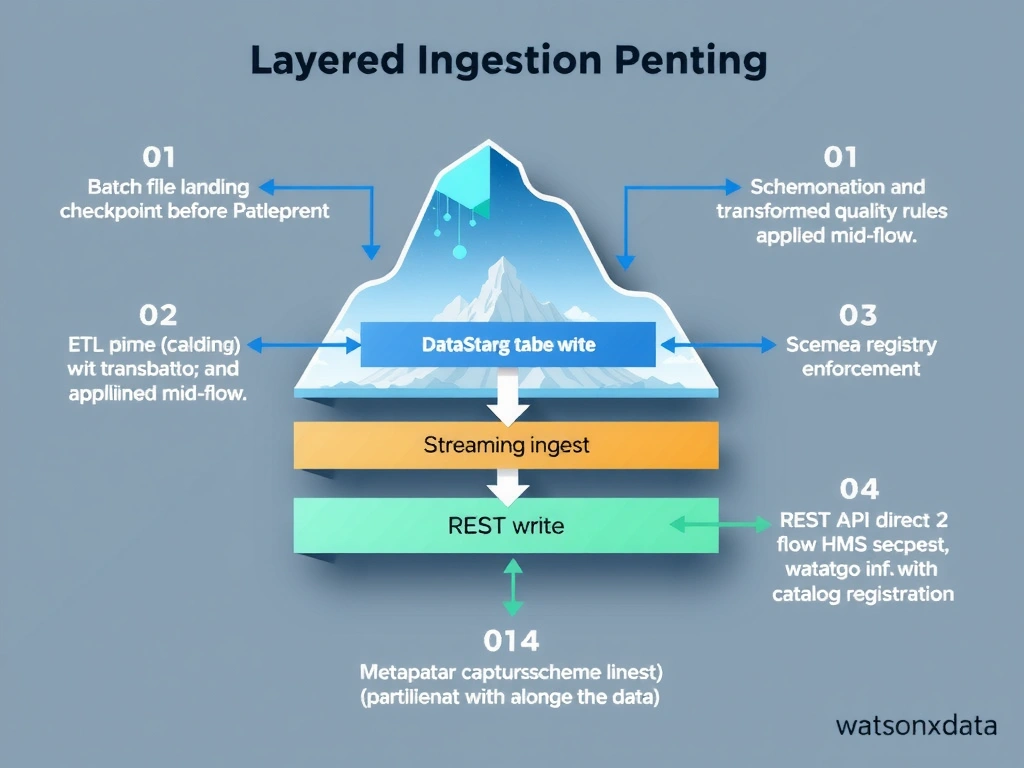
Think of it this way: designing your ingestion into watsonx.data is like planning a city's postal system — letters (batch files), packages (bulk loads), and express couriers (streaming) all need different handling. The key is choosing the pattern that preserves the envelope: the schema, quality flags, and governance metadata must travel WITH the data, not get stripped off at the loading dock.
Full explanation below image
Full Explanation
The correct answer is to choose ingestion patterns that preserve schema, quality, and governance expectations. In watsonx.data, ingestion options include: landing files directly to object storage buckets, using IBM DataStage for structured ETL with schema validation, using Kafka-based streaming ingestion for near-real-time feeds, or using the watsonx.data REST API for direct table writes. Option A (loading without validating structure) is wrong because schemaless ingestion creates downstream failures when query engines encounter unexpected data types or missing fields. Option C (skipping metadata capture until after production) is wrong because metadata — partition specs, table descriptions, column comments — is cheapest to capture at ingestion time; retroactively adding it requires re-reading and rewriting large datasets. Option D (ingesting only dashboard aggregates) is wrong because aggregates lose provenance and prevent users from answering new questions that the original aggregation didn't anticipate.