
A project lead is turning a proof of concept into a governed production workflow. What is the best way to handle predictive vs exploratory analytics while staying aligned with the certification objectives?
Select an answer to reveal the explanation.
Short Explanation and Infographic
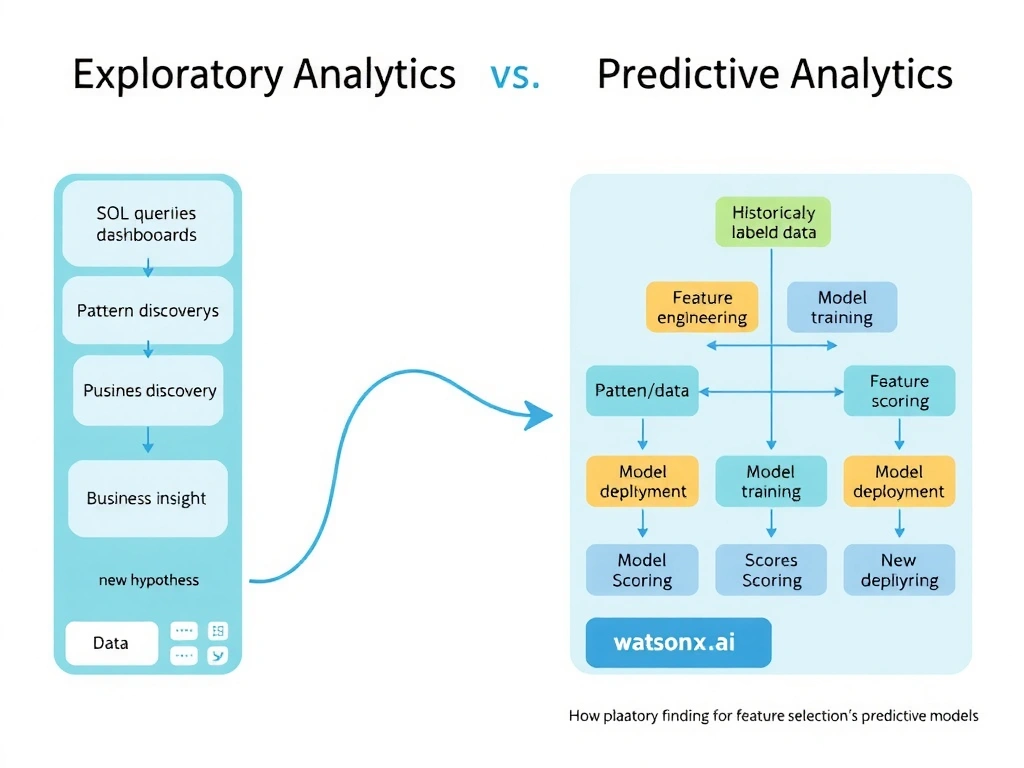
Think of it this way: exploratory analytics is like being a detective — you're poking through data without a predetermined answer, looking for patterns and anomalies. Predictive analytics is like being a meteorologist — you've got a trained model built from historical patterns and you're scoring new inputs to forecast an outcome. Both are valid; the mistake is treating ad-hoc SQL filters as a trained predictive model when they're actually just parameterized queries.
Full explanation below image
Full Explanation
The correct answer is to use exploratory analytics for discovery and predictive analytics for model-driven forecasting or scoring. In watsonx.data's consumption patterns, exploratory analytics involves SQL queries, dashboards, and ad-hoc analysis through Presto or Spark; predictive analytics involves ML models trained on watsonx.ai or Watson Studio, then scoring data that passes through the lakehouse. Option A (treating ad hoc filtering as a predictive model) is wrong because a SQL filter is a deterministic rule, not a probabilistic model — it has no learned weights, confidence intervals, or generalization capability. Option C (using predictive analytics when no historical data exists) is wrong because supervised predictive models require labeled historical data to train; without history, there is nothing to learn from, and the model would be meaningless. Option D (avoiding exploratory work before modeling) is wrong because exploratory analysis is how you understand data distribution, identify outliers, select features, and validate that your dataset is suitable for modeling — skipping it produces unreliable models.