
A team is preparing a production rollout and needs to avoid a design mistake. What is the best way to handle API access while staying aligned with the certification objectives?
Select an answer to reveal the explanation.
Short Explanation and Infographic
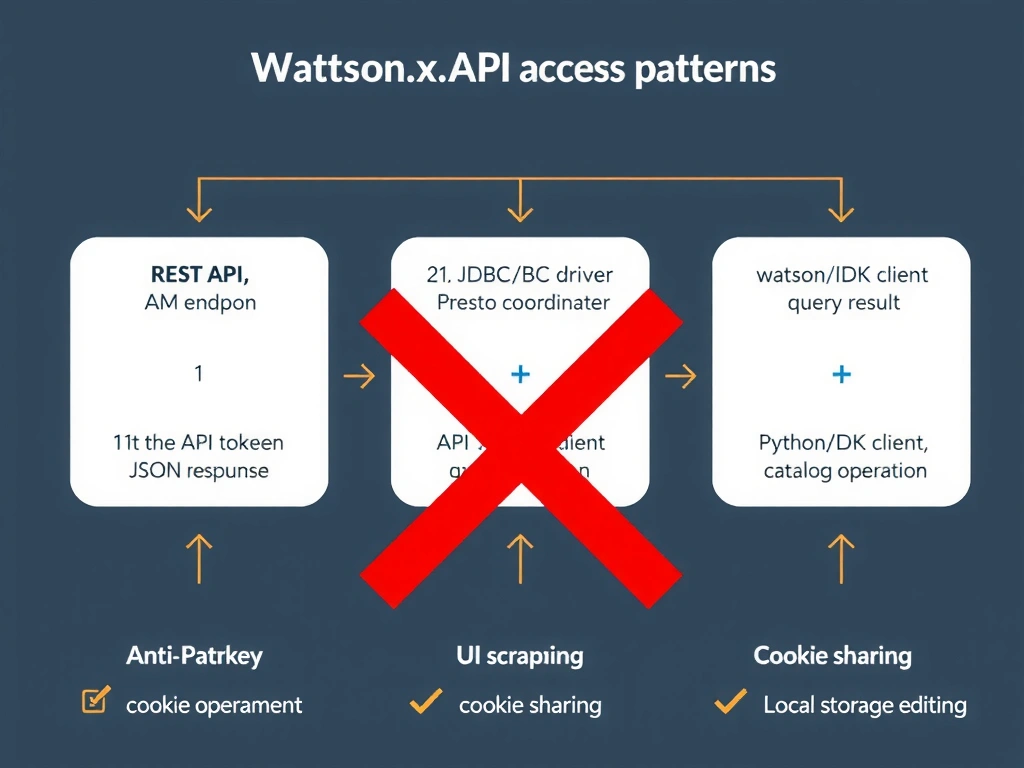
Think of it this way: watsonx.data's APIs are the service entrance to the building — legitimate apps and integrations use the proper door with proper credentials. Scraping the web UI is like prying open a window, and sharing admin cookies is like leaving the master key under the mat. Use the REST API, JDBC/ODBC drivers, or Presto client libraries the IBM-supported way, and your integrations will be stable, secure, and supportable.
Full explanation below image
Full Explanation
The correct answer is to use supported APIs and clients when applications need programmatic access to watsonx.data. IBM watsonx.data exposes a REST API for infrastructure management and catalog operations, plus JDBC/ODBC connectivity for SQL workloads through Presto and other engines. Option A (scraping the UI) is wrong because web scraping breaks with any UI update, has no SLA, violates IBM's terms of use, and bypasses authentication properly. Option B (sharing admin cookies) is wrong because it grants excessive privilege, lacks auditability, and creates a major security vulnerability — session tokens can be intercepted and abused. Option D (editing browser local storage) is wrong because local storage is a client-side cache, not a control plane, and modifying it to generate SQL is both technically incorrect and a security anti-pattern. Supported APIs provide versioned contracts, authentication via API keys or IAM tokens, and structured responses with error handling.