
A project lead is turning a proof of concept into a governed production workflow. The team is focused on data transformation. Which recommendation is most appropriate?
Select an answer to reveal the explanation.
Short Explanation and Infographic
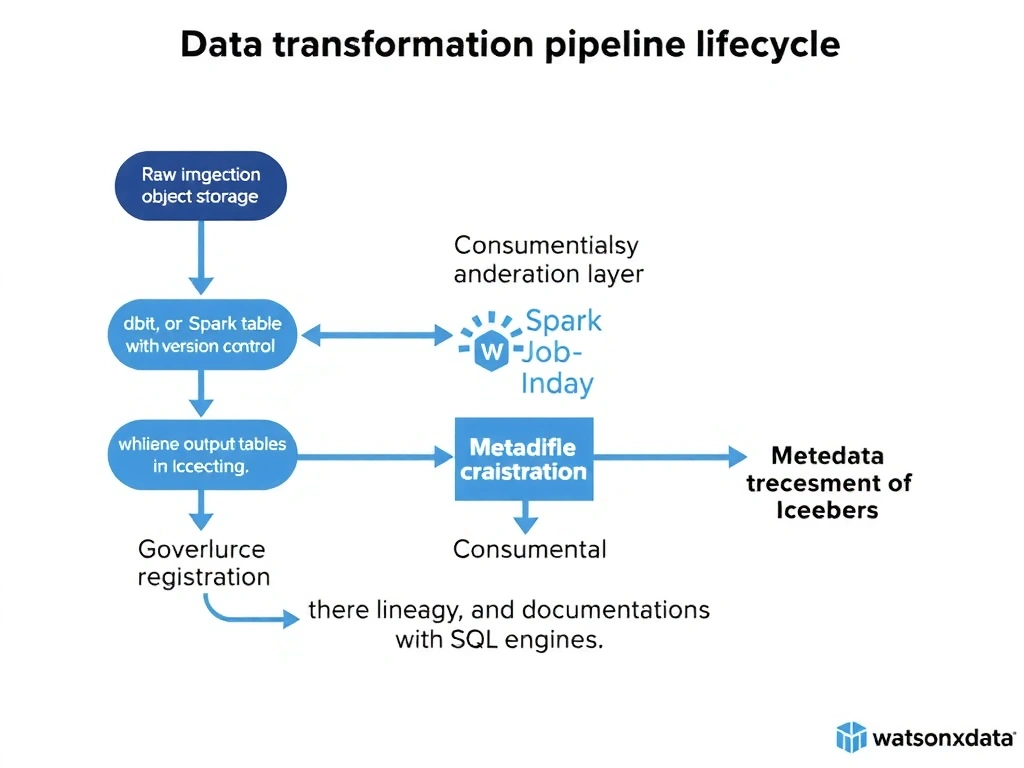
Here's the deal: transforming data in watsonx.data is like cooking in a professional kitchen — you don't prep a 200-person dinner on a personal cutting board. Move your transformations into controlled pipelines (dbt, Spark jobs, Manta flows) so every output is versioned, testable, and auditable. Personal notebooks and spreadsheets are fine for exploration, but production consumers need documented, repeatable tables — not mystery outputs.
Full explanation below image
Full Explanation
The correct answer is to transform data in controlled pipelines so consumers receive reliable, documented tables. In watsonx.data, this means using governed orchestration tools — dbt transformations, Spark jobs via IBM Analytics Engine, or pipeline services — that produce tables registered in the metadata catalog with lineage captured. Option A (hiding transformations in personal notebooks) fails because it breaks lineage, makes testing impossible, and creates single-point-of-failure logic. Option B (manual spreadsheets) introduces human error and defeats the purpose of a governed lakehouse. Option C (avoiding testing because SQL succeeded) is dangerous because a passing query does not validate business logic, data types, or edge-case handling across schema evolution. Production pipelines must be peer-reviewed, tested with sample data, and deployed through version-controlled processes.