
During a design review, an architect asks which choice best matches the IBM guidance. What is the best way to handle ACID table behavior while staying aligned with the certification objectives?
Select an answer to reveal the explanation.
Short Explanation and Infographic
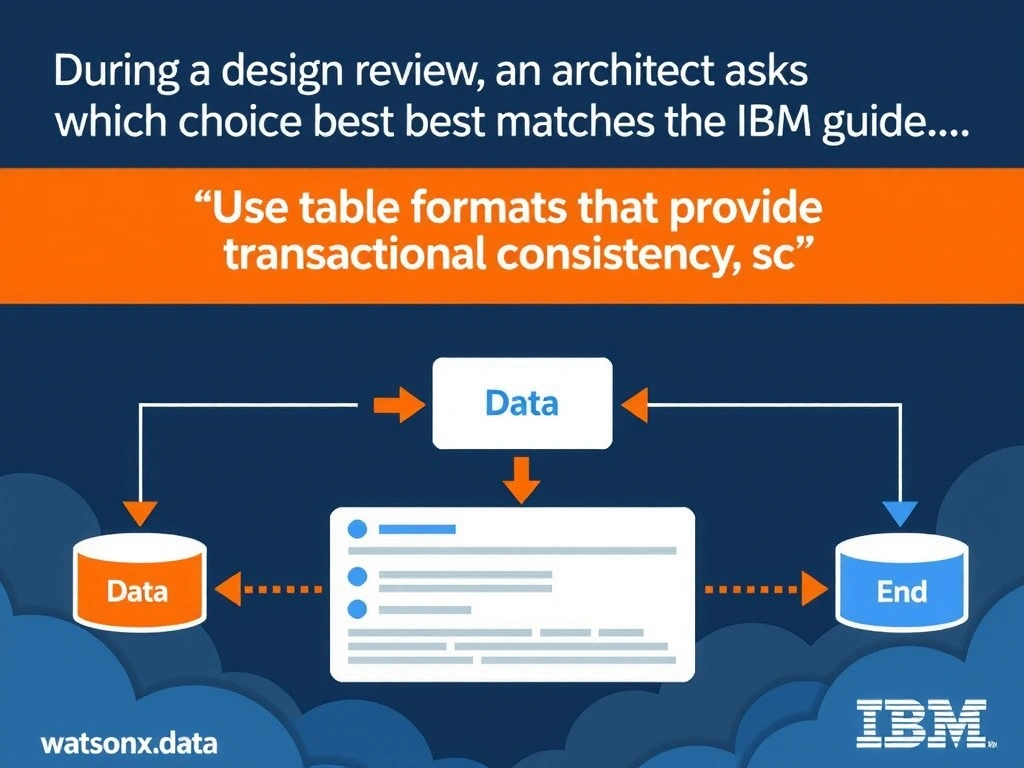
Here's the deal: ACID table behavior is not just a checkbox; it is the difference between a clean handoff and a late-night recovery call. In this scenario, answer B is the practical move because it keeps the implementation tied to the real IBM capability instead of chasing a shortcut. The other choices sound tempting, but they either skip governance, ignore operational reality, or solve the wrong problem.
Full explanation below image
Full Explanation
Here's the deal: ACID table behavior is not just a checkbox; it is the difference between a clean handoff and a late-night recovery call. In this scenario, answer B is the practical move because it keeps the implementation tied to the real IBM capability instead of chasing a shortcut. The other choices sound tempting, but they either skip governance, ignore operational reality, or solve the wrong problem.
The correct answer is B. Use table formats that provide transactional consistency, schema evolution, and reliable concurrent access. That aligns with the Domain 1: Data Lakehouse Fundamentals objective because it applies the feature or practice in the context where IBM expects a practitioner to use it. It also keeps the design reviewable, supportable, and realistic for a production environment.
Let's examine why the other options are incorrect: - Option A is incorrect because it sounds related, but it does not solve the ACID table behavior requirement described in the scenario. - Option C is incorrect because it removes visibility or governance at the exact point where the team needs it most. - Option D is incorrect because it uses an overbroad rule instead of matching the design to the actual workload and risk. For the exam, connect the feature to the operational outcome: the right answer is the one that preserves control, accuracy, and maintainability instead of relying on a brittle shortcut. The incorrect options ("Depend on file naming conventions for transactions", "Disable metadata tracking to reduce overhead", "Allow each query engine to rewrite files independently") are distractors that don't fully capture the concept described.