
What distinguishes prompt tuning from full fine-tuning of a foundation model?
Select an answer to reveal the explanation.
Short Explanation and Infographic
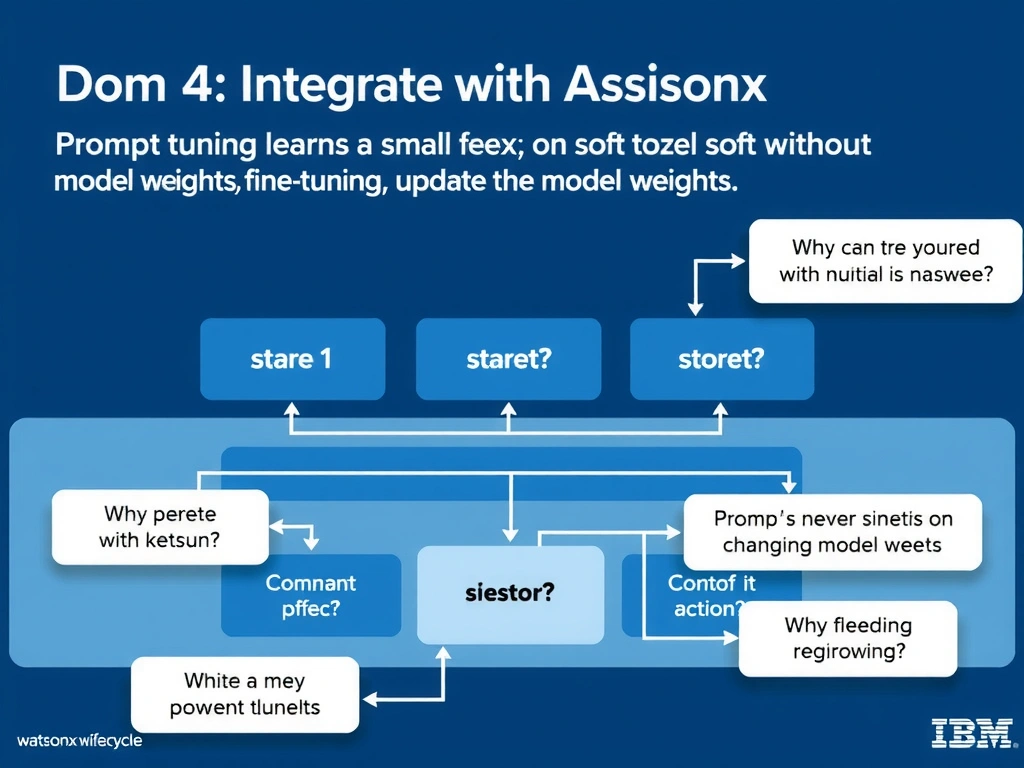
Todd Lammle: 'Imagine you're building a chatbot and this exact situation comes up — prompt tuning learns a small prefix of soft tokens without changing model weights; fine-tuning updates the model weights is your go-to move. Prompt tuning trains a small set of soft (continuous) prompt tokens prepended to inputs; keeping the underlying foundation model weights frozen. This is a classic Domain 4: Integrate with watsonx concept you'll want locked in before exam day.'
Full explanation below image
Full Explanation
Prompt tuning trains a small set of soft (continuous) prompt tokens prepended to inputs; keeping the underlying foundation model weights frozen. Full fine-tuning updates the actual model parameters. Both typically require training data. Prompt tuning is not limited to specific model families. The correct answer, "Prompt tuning learns a small prefix of soft tokens without changing model weights; fine-tuning updates the model weights", directly satisfies the scenario because it aligns with watsonx Assistant's design principles and the specific capability being tested. The incorrect options ("Prompt tuning updates all model weights; fine-tuning only updates a prefix layer", "Prompt tuning works only with IBM granite models; fine-tuning works universally", "Prompt tuning requires no training data; fine-tuning does") may appear relevant but each misses a key requirement or introduces a step that is either unnecessary or belongs to a different workflow. Mastering the distinction between these approaches is essential for effective watsonx Assistant implementations and is a core focus of the Domain 4: Integrate with watsonx section of the certification exam.