
A company has deployed their watsonx assistant to two channels: a web chat widget for customers requiring a 30-minute session timeout and custom branding, and a phone integration via the Voice Gateway for call center agents requiring a 5-minute session timeout and DTMF input support. How can these different channel configurations be managed in watsonx Assistant?
Select an answer to reveal the explanation.
Short Explanation and Infographic
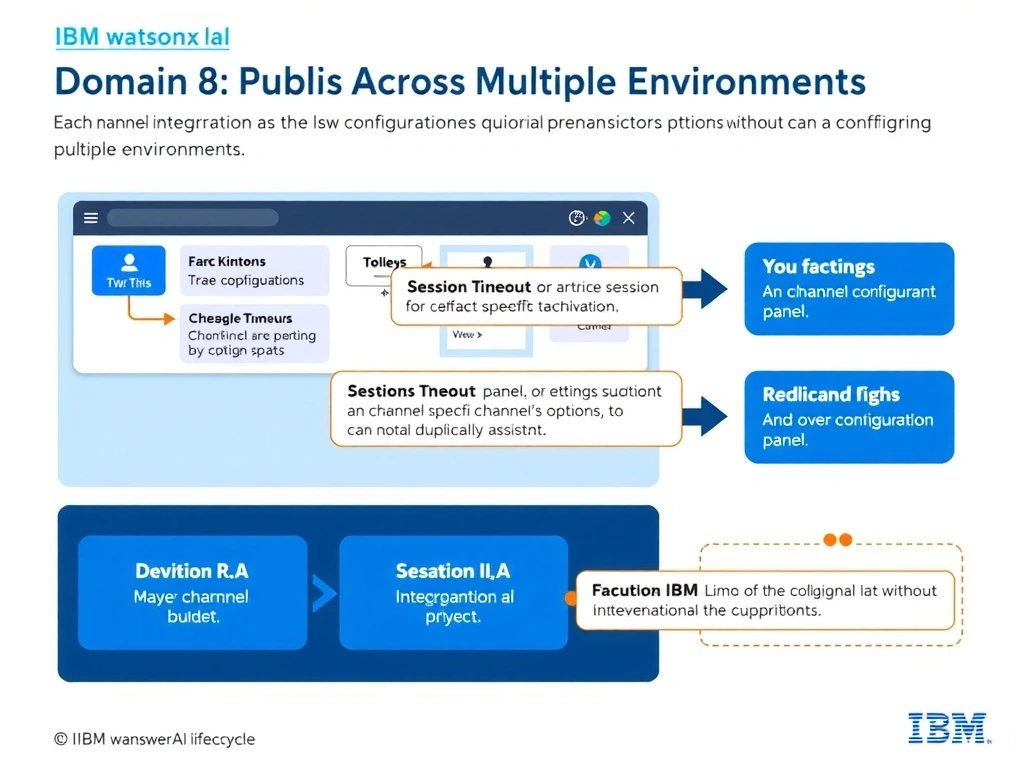
Todd Lammle: 'Imagine you're building a chatbot and this exact situation comes up — each channel integration in watsonx assistant has its own configuration panel where settings such as session timeout, appearance, and channel-specific options can be configured independently without duplicating the assistant is your go-to move. In watsonx Assistant, each channel integration — including web chat, phone (Voice Gateway), Slack, Microsoft Teams, and others — has its own dedicated configuration settings panel. This is a classic Domain 8: Publish Across Multiple Environments concept you'll want locked in before exam day.'
Full explanation below image
Full Explanation
In watsonx Assistant, each channel integration — including web chat, phone (Voice Gateway), Slack, Microsoft Teams, and others — has its own dedicated configuration settings panel. Developers can independently set session timeouts, appearance customizations (logo, color scheme), authentication options, and other channel-specific parameters for each integration. This eliminates the need for separate assistant instances and avoids complex runtime configuration logic, supporting clean multi-channel deployments from a single assistant. The correct answer, "Each channel integration in watsonx Assistant has its own configuration panel where settings such as session timeout, appearance, and channel-specific options can be configured independently without duplicating the assistant", directly satisfies the scenario because it aligns with watsonx Assistant's design principles and the specific capability being tested. The incorrect options ("The team must create two separate assistant instances — one for the web chat channel and one for the phone channel — because session timeout is a global instance-level setting that cannot vary by channel", "Session timeout and input method settings are controlled by IBM Cloud infrastructure limits and cannot be customized at the channel level within watsonx Assistant", "The assistant must detect the active channel at runtime using a custom webhook and call the management API during each session to apply the appropriate configuration dynamically") may appear relevant but each misses a key requirement or introduces a step that is either unnecessary or belongs to a different workflow. Mastering the distinction between these approaches is essential for effective watsonx Assistant implementations and is a core focus of the Domain 8: Publish Across Multiple Environments section of the certification exam.