
A regulated financial institution must maintain a tamper-evident audit trail recording every administrative change made to their watsonx Assistant instance — including who made the change, what was changed, and when. Which IBM Cloud service should be integrated to fulfill this requirement?
Select an answer to reveal the explanation.
Short Explanation and Infographic
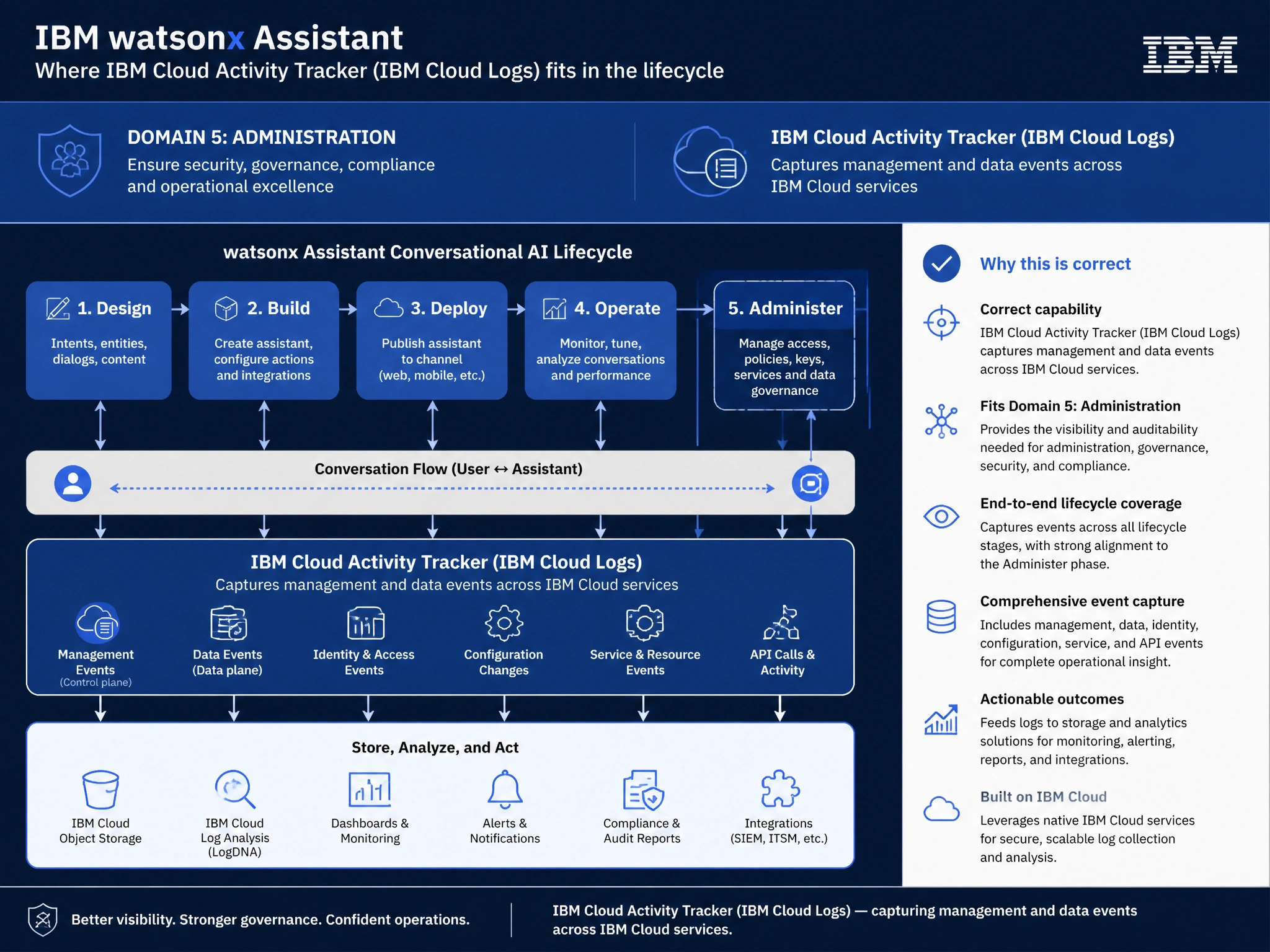
Todd Lammle: 'Imagine you're building a chatbot and this exact situation comes up — ibm cloud activity tracker (ibm cloud logs) — for capturing management and data events across ibm cloud services is your go-to move. IBM Cloud Activity Tracker (now integrated into IBM Cloud Logs) captures governance and compliance events generated by IBM Cloud services, including watsonx Assistant. This is a classic Domain 5: Administration concept you'll want locked in before exam day.'
Full explanation below image
Full Explanation
IBM Cloud Activity Tracker (now integrated into IBM Cloud Logs) captures governance and compliance events generated by IBM Cloud services, including watsonx Assistant. It records the initiator identity, action type, target resource, and timestamp for each administrative operation, providing the immutable audit log required by financial regulators such as SOX and PCI-DSS. The correct answer, "IBM Cloud Activity Tracker (IBM Cloud Logs) — for capturing management and data events across IBM Cloud services", directly satisfies the scenario because it aligns with watsonx Assistant's design principles and the specific capability being tested. The incorrect options ("IBM Cloud Monitoring (Sysdig) — for infrastructure-level metrics and alerting", "IBM Log Analysis — for aggregating application log streams from running workloads", "IBM Cloud Internet Services — for edge security and traffic management") may appear relevant but each misses a key requirement or introduces a step that is either unnecessary or belongs to a different workflow. Mastering the distinction between these approaches is essential for effective watsonx Assistant implementations and is a core focus of the Domain 5: Administration section of the certification exam.