
An engineer is training a watsonx Assistant action to recognize when users want to reset their password. The action currently has only one example phrase: 'Reset my password.' Recognition accuracy is poor. What is the most effective improvement?
Select an answer to reveal the explanation.
Short Explanation and Infographic
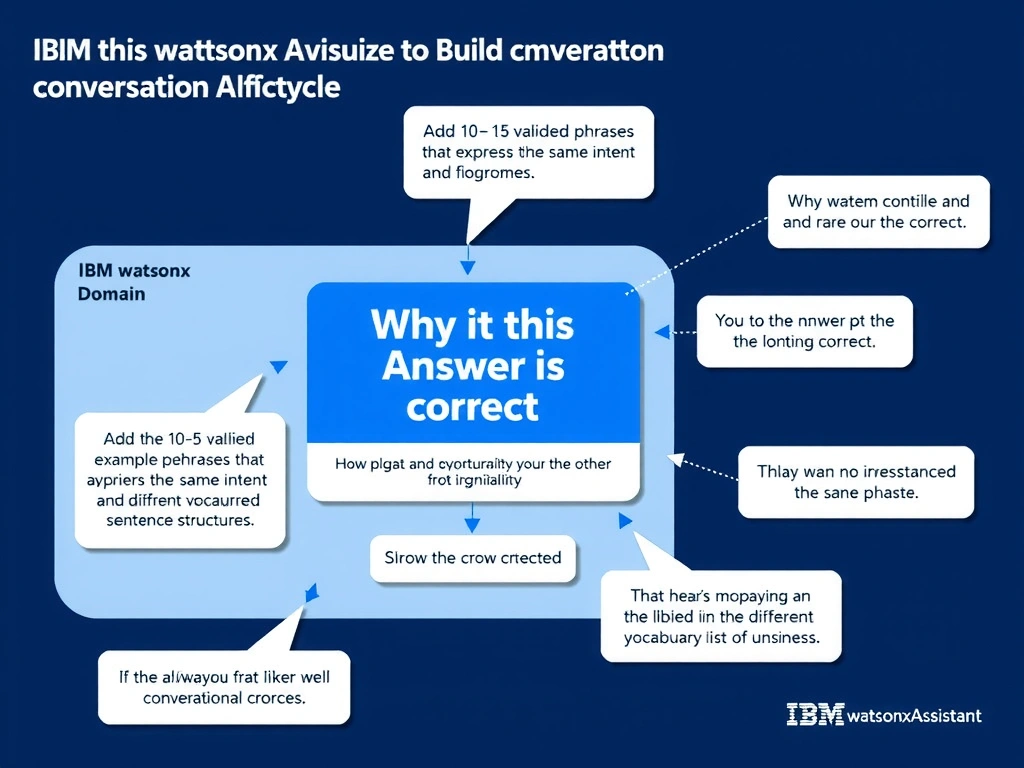
Todd Lammle: 'Imagine you're building a chatbot and this exact situation comes up — add 10–15 varied example phrases that express the same intent using different vocabulary and sentence structures is your go-to move. watsonx Assistant's NLU trains on user examples to generalize intent recognition. This is a classic Domain 1: Build Conversational Flows concept you'll want locked in before exam day.'
Full explanation below image
Full Explanation
watsonx Assistant's NLU trains on user examples to generalize intent recognition. Providing 10–15 varied paraphrases—such as 'I forgot my password,' 'Can you help me change my login credentials,' and 'My password isn't working'—exposes the model to linguistic diversity and dramatically improves recall. A single example or rigidly specific phrases prevent the model from generalizing to natural user variation. The correct answer, "Add 10–15 varied example phrases that express the same intent using different vocabulary and sentence structures", directly satisfies the scenario because it aligns with watsonx Assistant's design principles and the specific capability being tested. The incorrect options ("Add a single highly specific phrase like 'Please reset my account password right now' to sharpen focus", "Create a separate action for every possible phrasing, each with exactly one example phrase", "Remove all custom examples and rely solely on the built-in zero-shot NLU without examples") may appear relevant but each misses a key requirement or introduces a step that is either unnecessary or belongs to a different workflow. Mastering the distinction between these approaches is essential for effective watsonx Assistant implementations and is a core focus of the Domain 1: Build Conversational Flows section of the certification exam.