
A developer is setting up a watsonx Assistant to handle customer order status inquiries. They navigate to the Actions section and want to build a new conversational flow from scratch. What is the correct first step inside the Actions section to begin building this flow?
Select an answer to reveal the explanation.
Short Explanation and Infographic
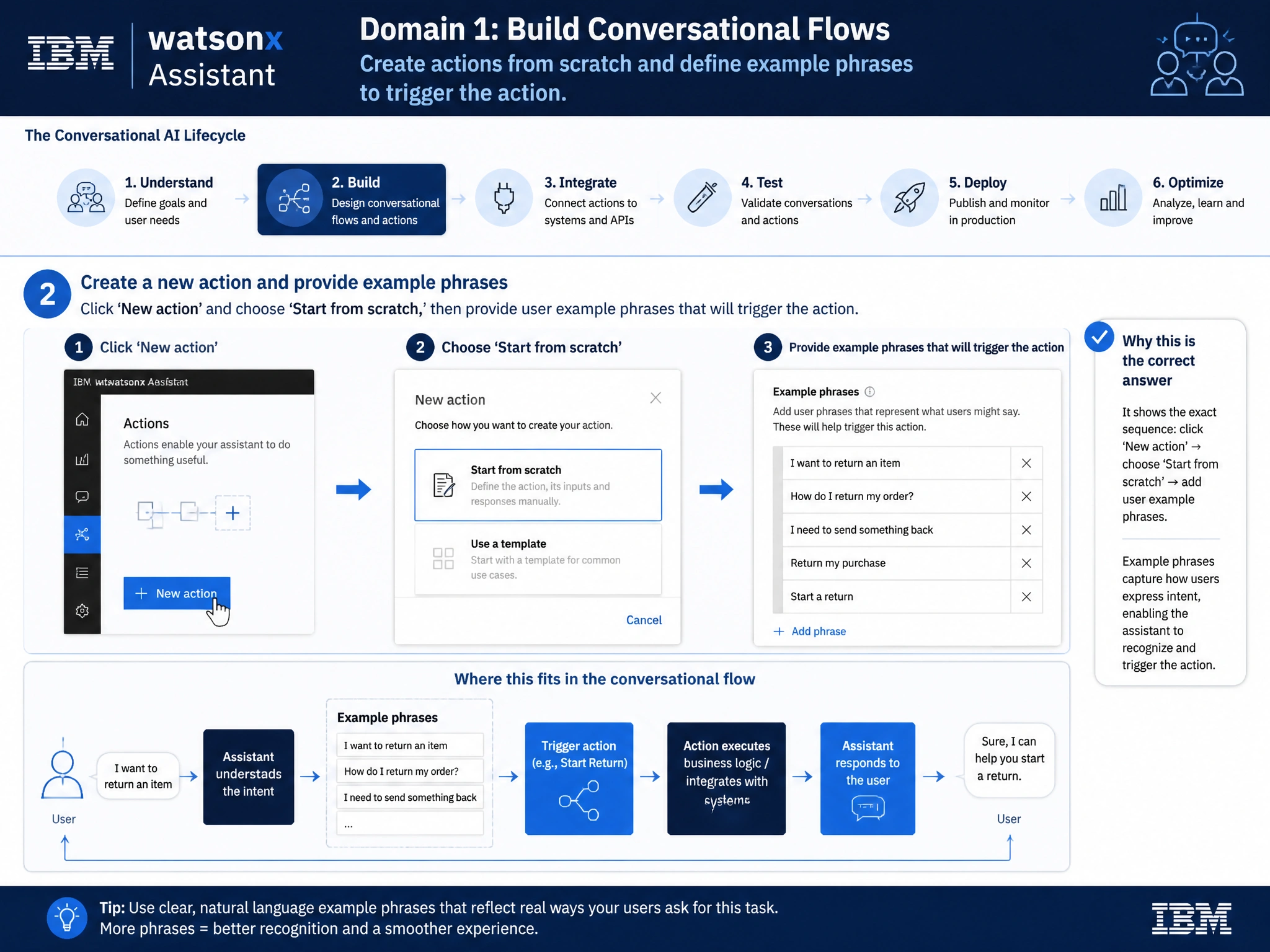
Todd Lammle: 'Imagine you're building a chatbot and this exact situation comes up — click 'new action' and choose 'start from scratch,' then provide user example phrases that will trigger the action is your go-to move. In watsonx Assistant actions-based flows, you begin by clicking 'New action' and selecting 'Start from scratch. This is a classic Domain 1: Build Conversational Flows concept you'll want locked in before exam day.'
Full explanation below image
Full Explanation
In watsonx Assistant actions-based flows, you begin by clicking 'New action' and selecting 'Start from scratch.' You then supply example phrases (training utterances) that teach the NLU when to invoke this action. Dialog nodes are a legacy concept; the modern actions paradigm does not require them to start a new flow. The correct answer, "Click 'New action' and choose 'Start from scratch,' then provide user example phrases that will trigger the action", directly satisfies the scenario because it aligns with watsonx Assistant's design principles and the specific capability being tested. The incorrect options ("Create a dialog node first and then link it to the new action builder to define the flow", "Define a custom extension and webhook before creating any action so data can be fetched immediately", "Set all required global session variables before adding the first action to the workspace") may appear relevant but each misses a key requirement or introduces a step that is either unnecessary or belongs to a different workflow. Mastering the distinction between these approaches is essential for effective watsonx Assistant implementations and is a core focus of the Domain 1: Build Conversational Flows section of the certification exam.