A computer vision engineer is training a convolutional neural network (CNN) to classify images but has a limited number of training samples. They decide to apply data augmentation. What is the main purpose of this technique?
Select an answer to reveal the explanation.
Short Explanation and Infographic
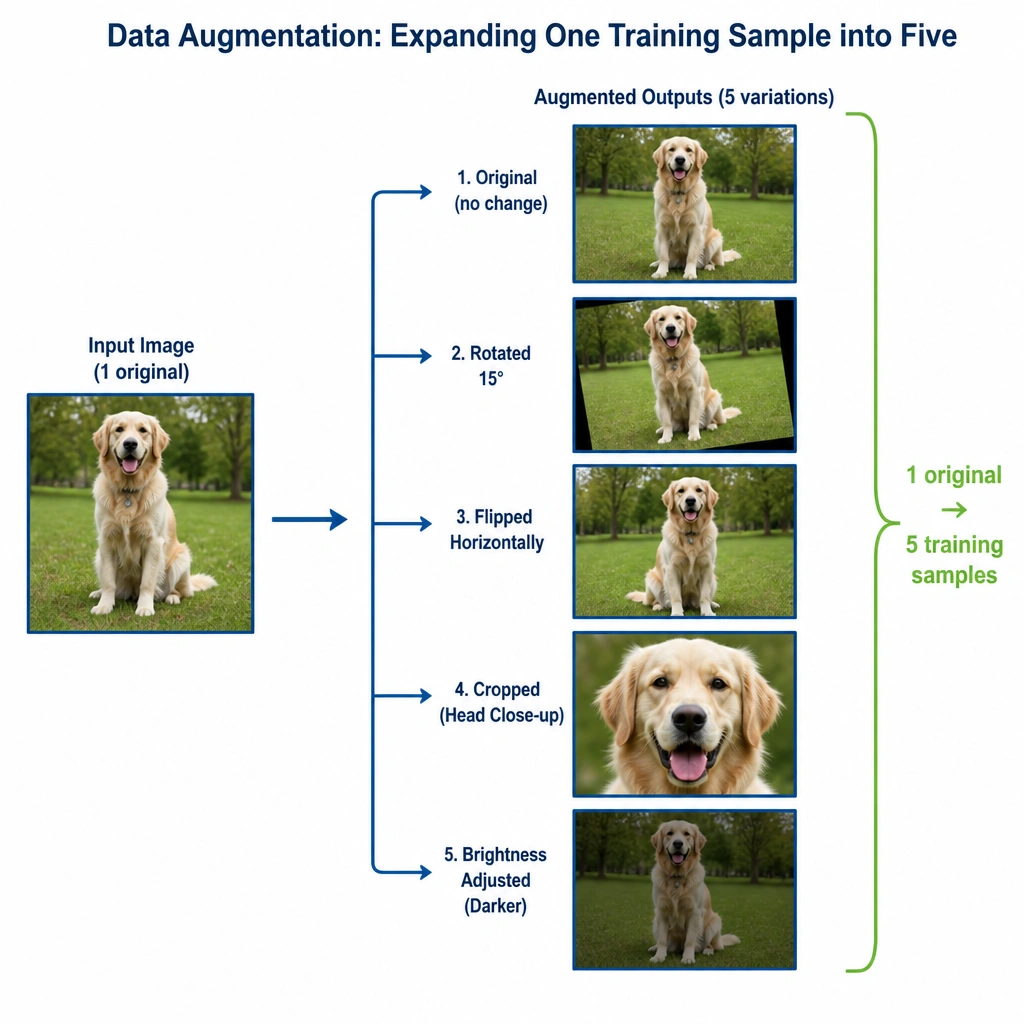
Imagine this: you're training a model to recognize cats, but all your training photos show cats sitting perfectly upright. If your model sees a cat lying on its side, it might completely freeze up. Data augmentation is the fix. Think of it like taking a photo and spinning it, flipping it upside down, cropping it, or changing the lighting. You aren't collecting new photos—you are just taking the ones you already have and making modified copies of them. This teaches the network that a cat is still a cat, no matter what angle or lighting it's in. It increases your training data size and prevents the model from overfitting to your specific training images. Trust me, in computer vision, data augmentation is a mandatory best practice if you want your model to survive in the real world!
Full explanation below image
Full Explanation
In computer vision, deep learning models like Convolutional Neural Networks (CNNs) require vast amounts of diverse training data to generalize well to unseen images. However, collecting and labeling new images is often expensive and time-consuming. Data augmentation is a technique used to artificially expand the training dataset by creating modified versions of existing images. This is accomplished by applying various geometric and photometric transformations to the original images, such as random rotations, horizontal and vertical flips, translations, scaling, cropping, shearing, and color/brightness jittering. By training the network on these variations, data augmentation teaches the model to be invariant to these transformations. For instance, a horizontal flip teaches the model that an object (such as a car) is still the same object regardless of the direction it is facing. This effectively reduces overfitting and improves the model's robustness and generalization capabilities when deployed in real-world scenarios where camera angles and lighting conditions vary. Let's look at why the other options are incorrect: Option A describes image compression or downsampling, which reduces resolution but does not increase dataset diversity. Option B refers to data cleaning or deduplication, which focuses on removing unwanted data rather than generating variations. Option D describes pixel normalization or standardization, which is a scaling preprocessing step used to ensure numerical stability during training, not data augmentation. Therefore, the correct answer is C because it directly describes the artificial expansion of the dataset through image modifications.