An NLP developer is designing a text cleaning pipeline and must decide between using stemming or lemmatization to normalize word variations. What is the fundamental difference between these two techniques?
Select an answer to reveal the explanation.
Short Explanation and Infographic
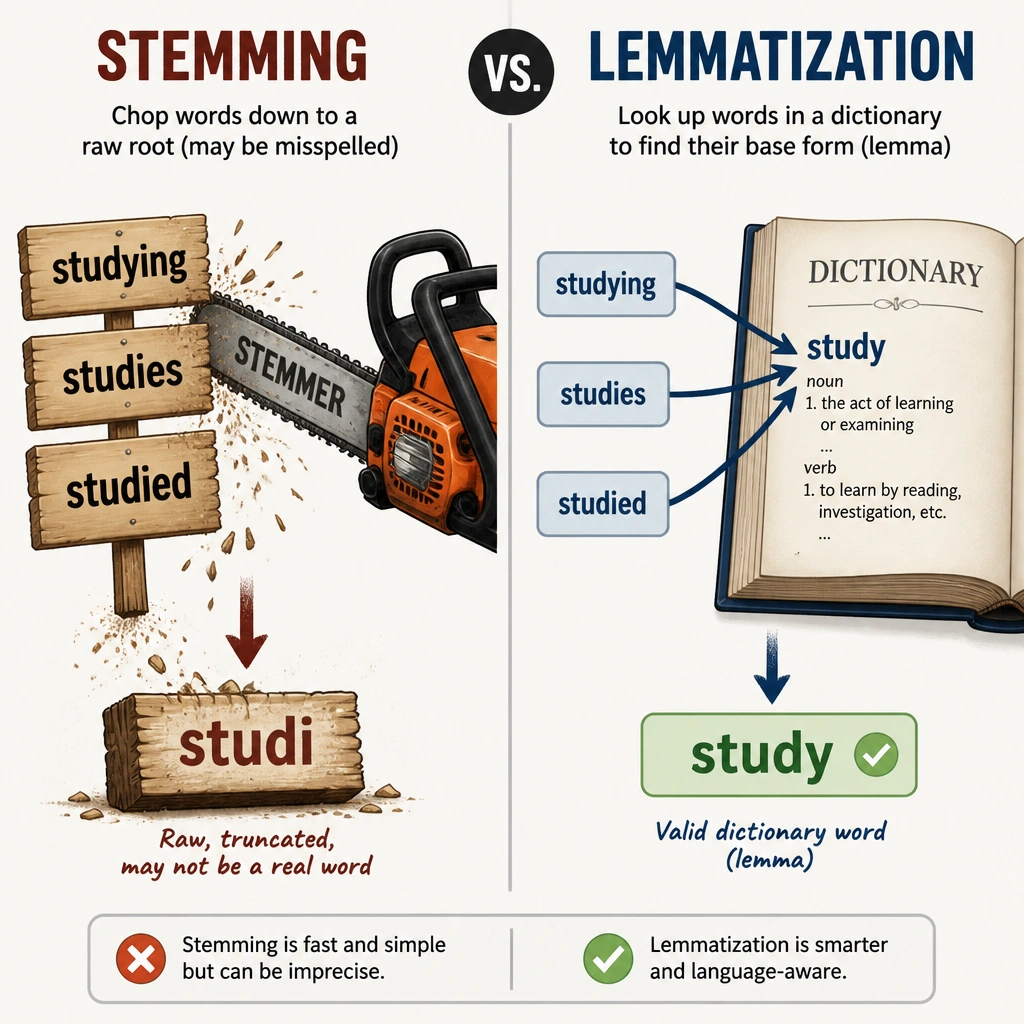
Here's the deal: both stemming and lemmatization are trying to do the same basic job—they want to shrink your vocabulary by grouping variations of a word together. But how they do it is totally different. Think of stemming like a guy with a machete. He just chops off the suffixes like 'ing' or 'ed' using basic rules. If you run 'studies' through a stemmer, it might spit out 'studi'—which isn't even a real English word! Lemmatization, on the other hand, is like a trained linguist. It looks at the word, considers its part of speech, checks a dictionary, and returns the actual root, 'study'. Sure, lemmatization takes more CPU cycles because of those lookups, but it gives you clean, meaningful data. Remember this for the exam: stemming is crude and fast, while lemmatization is smart and grammatically accurate. Got it? Sweet.
Full explanation below image
Full Explanation
In natural language processing (NLP), both stemming and lemmatization are text normalization techniques used to reduce words to their base or root forms. However, their underlying mechanisms and outputs differ significantly. Stemming is a heuristic, rule-based approach that strips characters from the ends of words (such as suffixes like '-ing', '-ed', '-s') without considering grammatical context. Algorithms like the Porter Stemmer use predefined rules to truncate words. Because it is purely algorithmic character-chopping, stemming is computationally very fast, but it often results in stems that are not actual dictionary words (e.g., 'community' becomes 'commun', or 'universe' and 'university' both reduce to 'univers'). Lemmatization, by contrast, performs a full morphological analysis of words by referencing a vocabulary (dictionary) and considering the word's part of speech (POS) within the sentence. For example, running 'better' through a lemmatizer returns 'good', whereas a stemmer would likely leave it unchanged or chop it incorrectly. Similarly, 'was' lemmatizes to 'be'. Lemmatization ensures that the returned base form (the lemma) is always a valid dictionary word. Let's review the incorrect options: Option A reverses the definitions, falsely attributing dictionary lookups to stemming. Option C is incorrect because neither technique is a deep learning model; they are algorithmic preprocessing steps, and lemmatization is the one that is more computationally demanding. Option D is incorrect because both techniques can be applied to all parts of speech (verbs, nouns, adjectives, etc.) to normalize text. Therefore, stemming uses crude heuristics to slice off suffixes, while lemmatization leverages linguistic rules and dictionary lookups to find the true root.