What is the primary defining characteristic that distinguishes deep learning from traditional, shallow machine learning algorithms?
Select an answer to reveal the explanation.
Short Explanation and Infographic
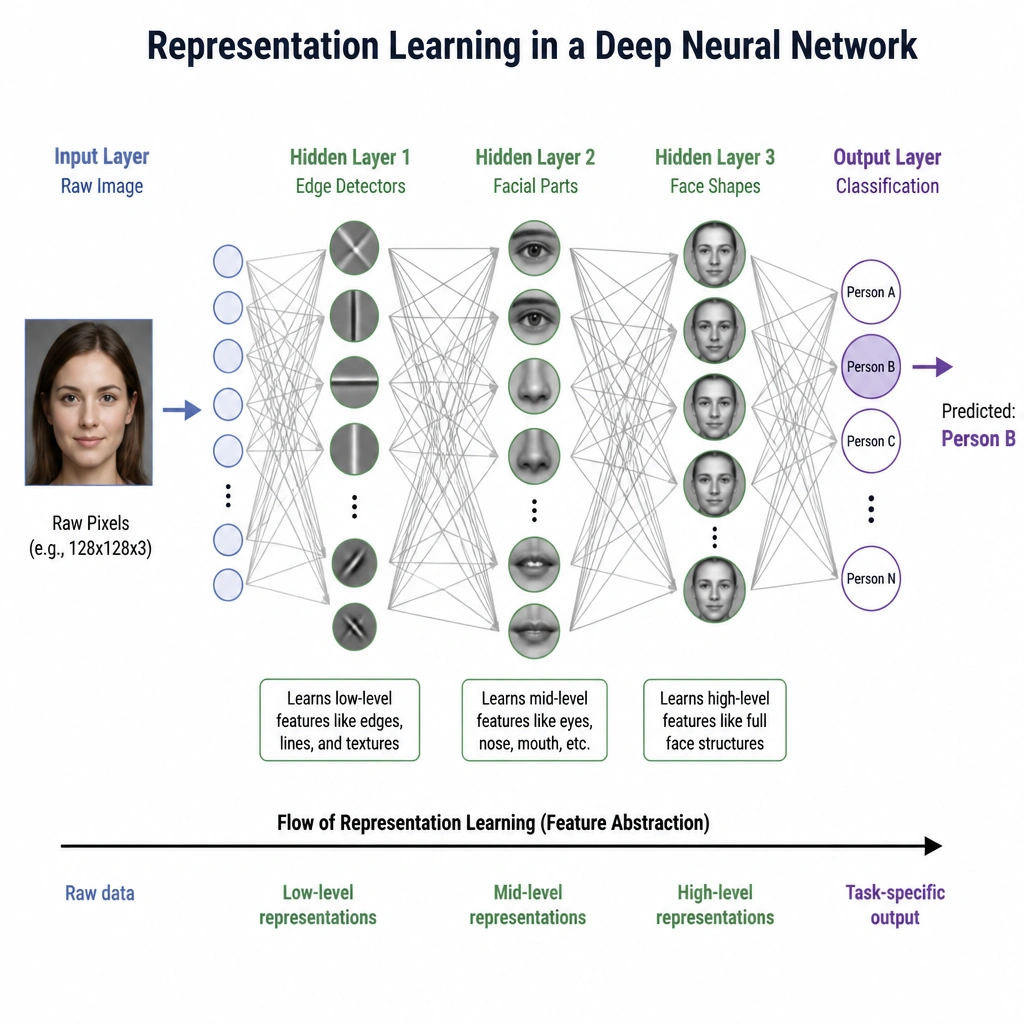
Check this out: in traditional machine learning, like logistic regression or support vector machines, you have to spend a ton of time doing 'feature engineering.' That's a fancy way of saying you have to manually extract the important features from the raw data before passing it to the model. If you're building a car detector, you have to write code to find wheels, windows, and headlights first. Deep learning changes the game completely. By using multiple hidden layers in a deep neural network, the model learns to do this automatically. The first layer might find simple edges, the next layer combines those edges to find shapes, and the deep layers recognize whole objects. That's why we call it 'deep'—it has a stack of hidden layers that do the heavy lifting of feature extraction for you. Neat, right?
Full explanation below image
Full Explanation
Deep learning is a specialized subset of machine learning based on artificial neural networks. The defining characteristic of deep learning is its deep architecture, consisting of an input layer, an output layer, and multiple successive hidden layers (often dozens or hundreds). This deep hierarchical structure enables several key capabilities: 1) Feature Hierarchy (Representation Learning): Instead of relying on domain experts to manually design and extract features (such as SIFT features in computer vision or phonemes in speech recognition), deep neural networks learn representations directly from raw data (like raw pixels or audio waveforms). 2) Hierarchical Extraction: Early layers of the network learn basic, low-level features (e.g., edges, gradients). Middle layers combine these to form mid-level features (e.g., textures, shapes). The deepest layers combine these mid-level representations to recognize high-level semantic concepts (e.g., faces, objects, words). 3) Non-linear Transformation: Each layer applies non-linear activation functions (like ReLU), allowing the network to approximate highly complex, non-linear functions. Other options are incorrect: deep learning is not restricted to classification (Option A) and is widely used for regression, generative modeling, and reinforcement learning; single-layer networks (Option B) are shallow architectures (like the original Perceptron) and cannot learn complex non-linear patterns; and manual feature engineering (Option D) is a limitation of traditional machine learning that deep learning actively circumvents.