As AI systems ingest massive volumes of information to train large-scale models, which of the following represents a primary ethical concern specifically related to user data privacy?
Select an answer to reveal the explanation.
Short Explanation and Infographic
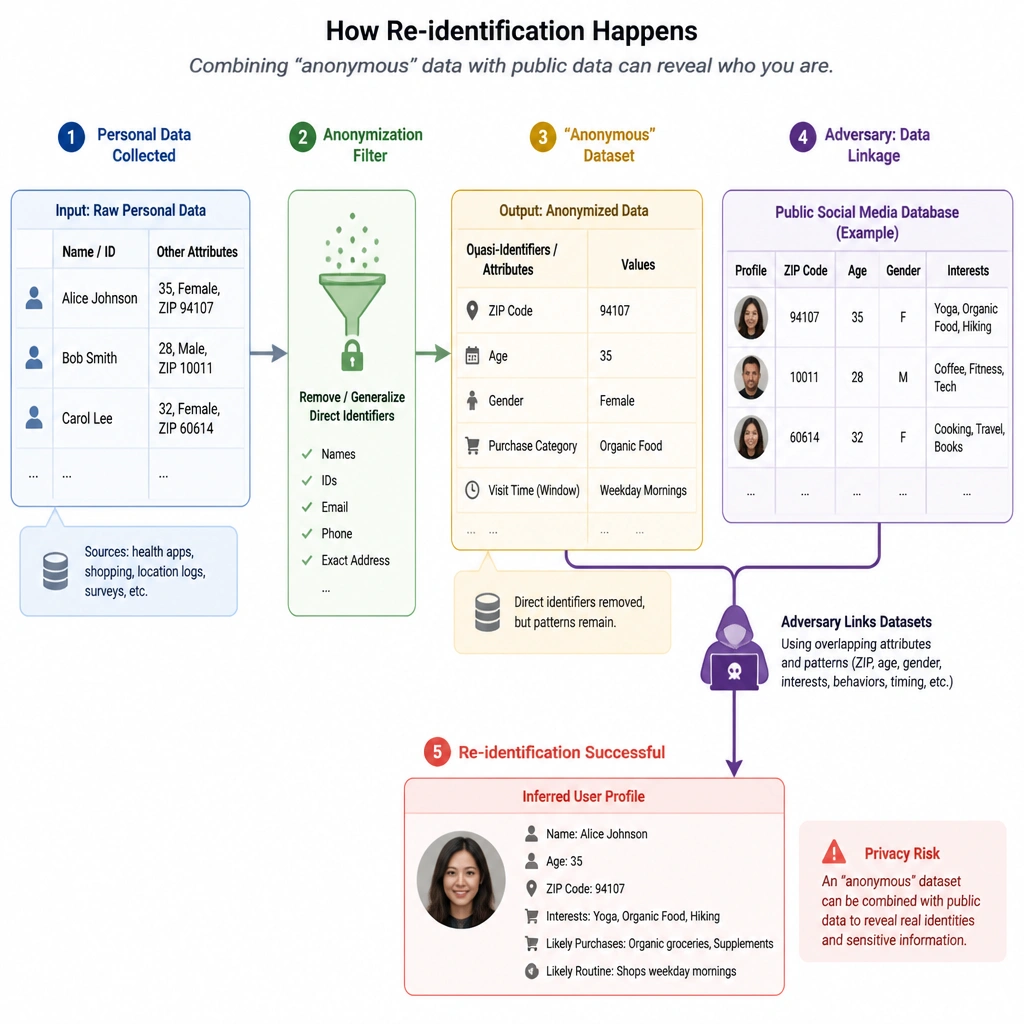
Check this out: everyone wants to build the smartest AI, and to do that, you need data—lots of it. But in the rush to feed the beast, a lot of companies scrape personal data without asking. That is a massive privacy violation and a huge ethical minefield. And don't think you're safe just because you 'anonymized' the data by stripping names. In the real world, hackers and researchers can take that anonymized data, cross-reference it with other public datasets, and figure out exactly who you are. This is called re-identification. While things like training times, model accuracy, and feature counts are important engineering problems, they aren't data privacy issues. Remember, as AI developers, we have to respect user consent and protect data at all costs.
Full explanation below image
Full Explanation
Data privacy is one of the most critical ethical frontiers in artificial intelligence. Because modern machine learning models (especially deep learning architectures) require vast amounts of data to achieve high performance, developers frequently collect extensive user datasets. This creates significant ethical risks, primarily centered around consent and data protection: 1) Lack of Informed Consent: Many datasets are collected through web scraping, telemetry, or obscure terms-of-service agreements without the explicit, informed consent of the individuals whose data is being utilized. 2) Re-identification Risks: A common practice is to 'anonymize' datasets by removing direct identifiers (like names or social security numbers). However, metadata, behavioral patterns, and geographic data often remain. Using linkage attacks—where an anonymous dataset is cross-referenced with auxiliary public datasets (such as voter registration lists or social media feeds)—adversaries can frequently re-identify specific individuals. 3) Data Security and Leakage: Large models can sometimes memorize sensitive training data. Techniques like membership inference attacks can determine if a specific individual's data was used to train a model, potentially exposing private information. To counter these concerns, modern AI development emphasizes privacy-preserving techniques like differential privacy, federated learning, and strict compliance with regulations such as GDPR and CCPA. The other choices, while representing real issues in AI (such as environmental impact or technical interpretability), do not describe data privacy concerns.