When designing an enterprise MLOps (Machine Learning Operations) production pipeline, why is it critical to implement robust model versioning?
Select an answer to reveal the explanation.
Short Explanation and Infographic
Check this out: in traditional software, you version-control your code using Git, and life is good. But machine learning is a different beast. A working model isn't just code—it's the code plus the exact dataset used to train it, plus the resulting model weights (the artifact). Imagine your boss walks in on a Monday morning and says, 'Hey, that model we deployed last week is making weird predictions. We need to recreate it and debug it right now.' If you don't have model versioning, you're in deep trouble because you won't know which dataset or code branch created that specific model. By versioning your models, code, and data together, you can easily reproduce any training run, rollback to a known good version if things break in production, and keep auditors happy. Trust me on this, it's the backbone of solid MLOps.
Full explanation below image
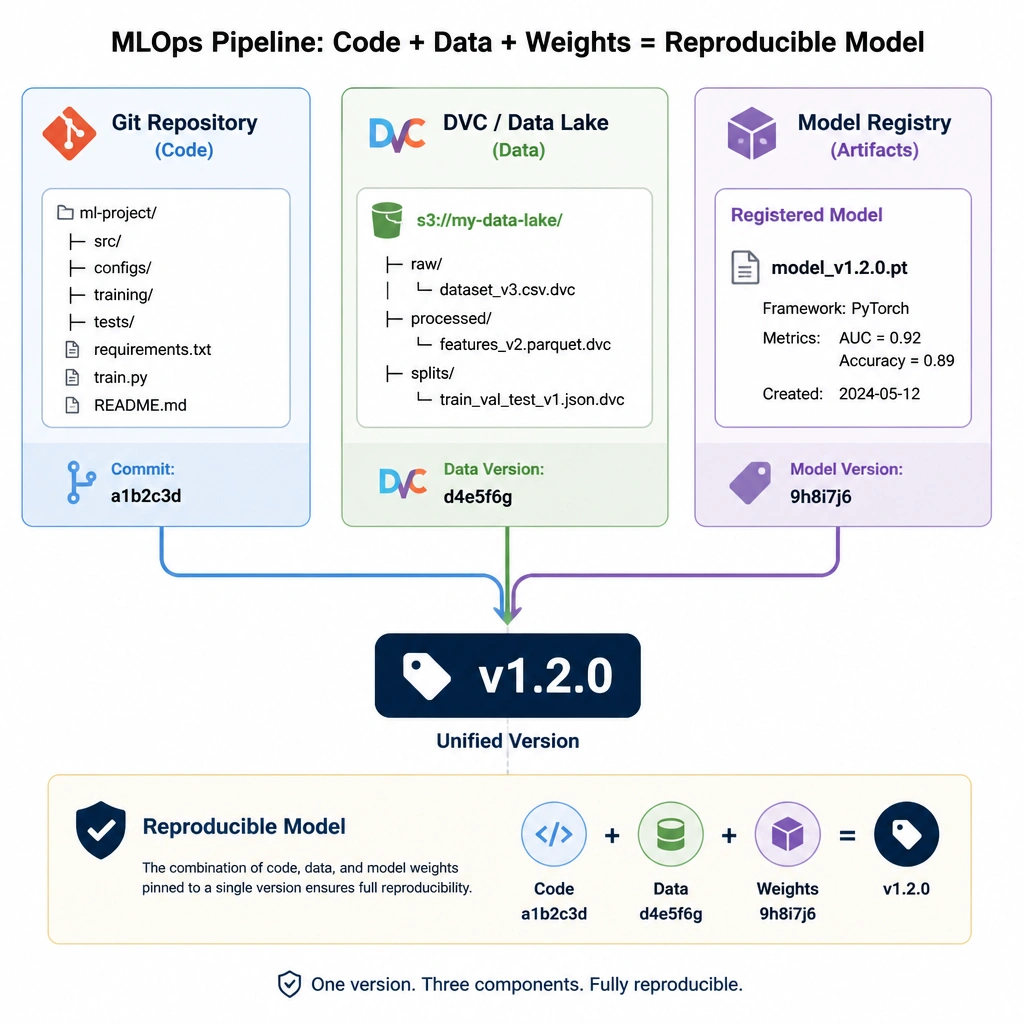
Full Explanation
Model versioning is a foundational pillar of Machine Learning Operations (MLOps) that extends beyond traditional software version control. In standard software development, tracking source code changes using tools like Git is sufficient. However, a machine learning model's behavior is determined by a combination of three distinct components: the training code (algorithms, hyperparameters), the specific datasets used for training and validation, and the resulting binary model weights (artifacts). The primary objective of model versioning in an MLOps pipeline is to ensure reproducibility, auditability, and operational resilience. If a model behaves unexpectedly in production, engineers must be able to recreate the exact training environment, code state, and data inputs to debug the issue. Furthermore, in regulated industries (like finance and healthcare), organizations must prove how a model made a specific decision, which requires an audit trail linking the deployed model back to its exact training data and code version. Finally, if a newly deployed model exhibits performance degradation, versioning allows operations teams to instantly rollback to a previous, stable version. Other options are incorrect because versioning does not scale the size of a model, accelerate training speed (which is handled by hardware acceleration or distributed training), or primarily serve to delete old files.