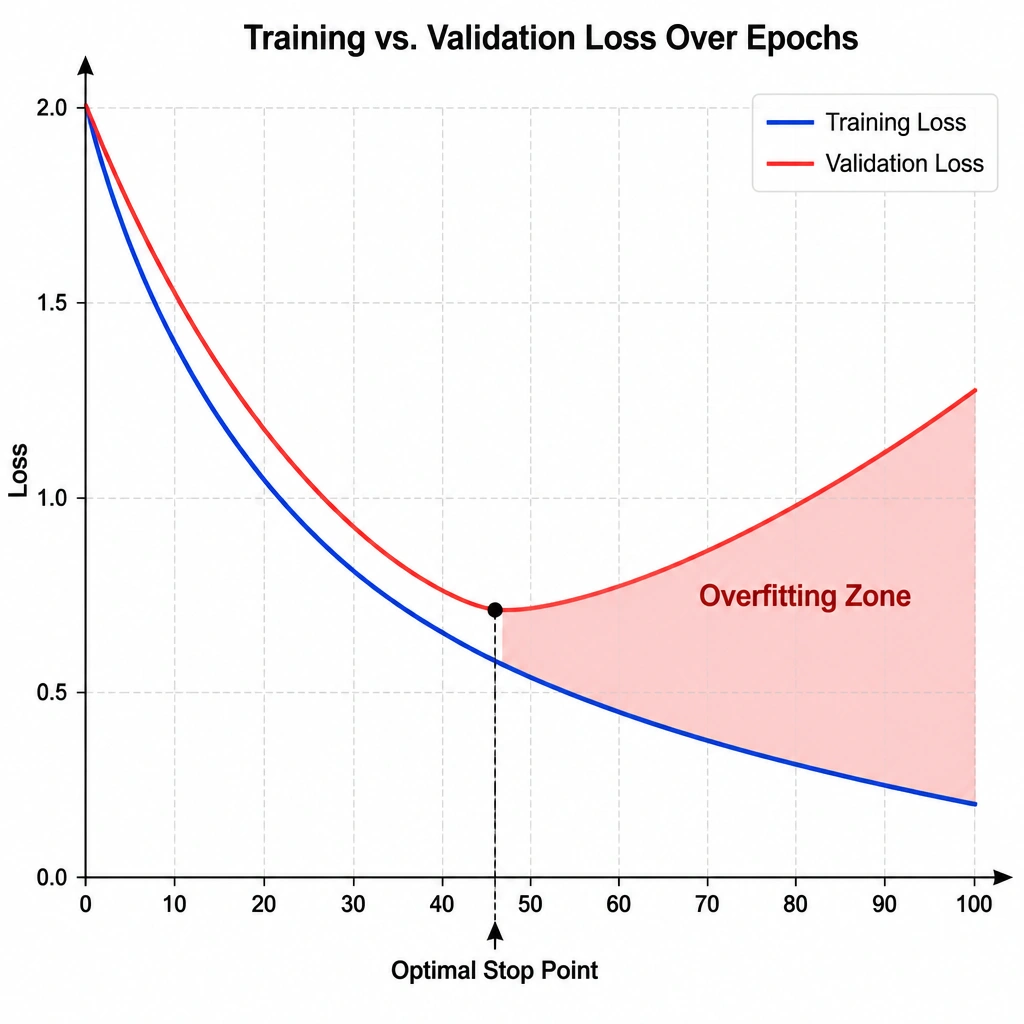
While training a deep learning model, you plot the loss curves. You notice that the training loss continues to drop steadily, but the validation loss reaches a minimum and then begins to climb upward. What problem is the model experiencing?
Select an answer to reveal the explanation.
Short Explanation and Infographic
Pay close attention here, because this one bites people in production all the time. You're training your model, and the training loss curve looks beautiful, dropping lower and lower. You're feeling good. But then you look at the validation loss — the curve for the data the model hasn't seen during training. It started off dropping, but now it's climbing back up! What's happening? Your model has overfit. It's stopped learning general patterns and has started memorizing the training data, including all the noise and outliers. It's like a student who memorized the practice test word-for-word but fails the actual exam because the questions are worded slightly differently.
Full explanation below image
Full Explanation
Overfitting occurs when a machine learning model learns the training data too well, capturing the noise, random fluctuations, and specific details of the training set rather than the underlying general relationships. This degrades the model's ability to generalize to new, unseen data.
The classic signature of overfitting is a diverging trend between training and validation metrics. As training progress continues: - The training loss continues to decrease because the model parameters are continuously optimized to fit the training examples. - The validation loss initially decreases but eventually hits a minimum and starts to increase. This divergence indicates that while the model is getting better at predicting the training set, its performance on validation data (unseen data representing real-world generalization) is actively worsening.
Common causes of overfitting include excessive model complexity (too many parameters relative to the amount of training data), training for too many epochs, or lack of regularization. Solutions include early stopping, applying dropout, adding L1/L2 regularization, or collecting more training data.
Let's address the distractors: - A small dataset (Option B) can make a model more prone to overfitting, but the direct signal described (training loss decreasing while validation loss increases) is the definition of overfitting itself, not the dataset size. - Underfitting (Option C) is characterized by both training and validation loss remaining high because the model is too simple to learn the data. - A learning rate that is too low (Option D) would result in extremely slow convergence where both losses decrease very slowly, but it would not cause validation loss to diverge and increase.
Therefore, overfitting is the correct answer.