When processing long sequences of text or time-series data, standard Recurrent Neural Networks (RNNs) often fail because gradients shrink to zero during backpropagation, causing the network to forget early information. Why does a Long Short-Term Memory (LSTM) network solve this issue?
Select an answer to reveal the explanation.
Short Explanation and Infographic
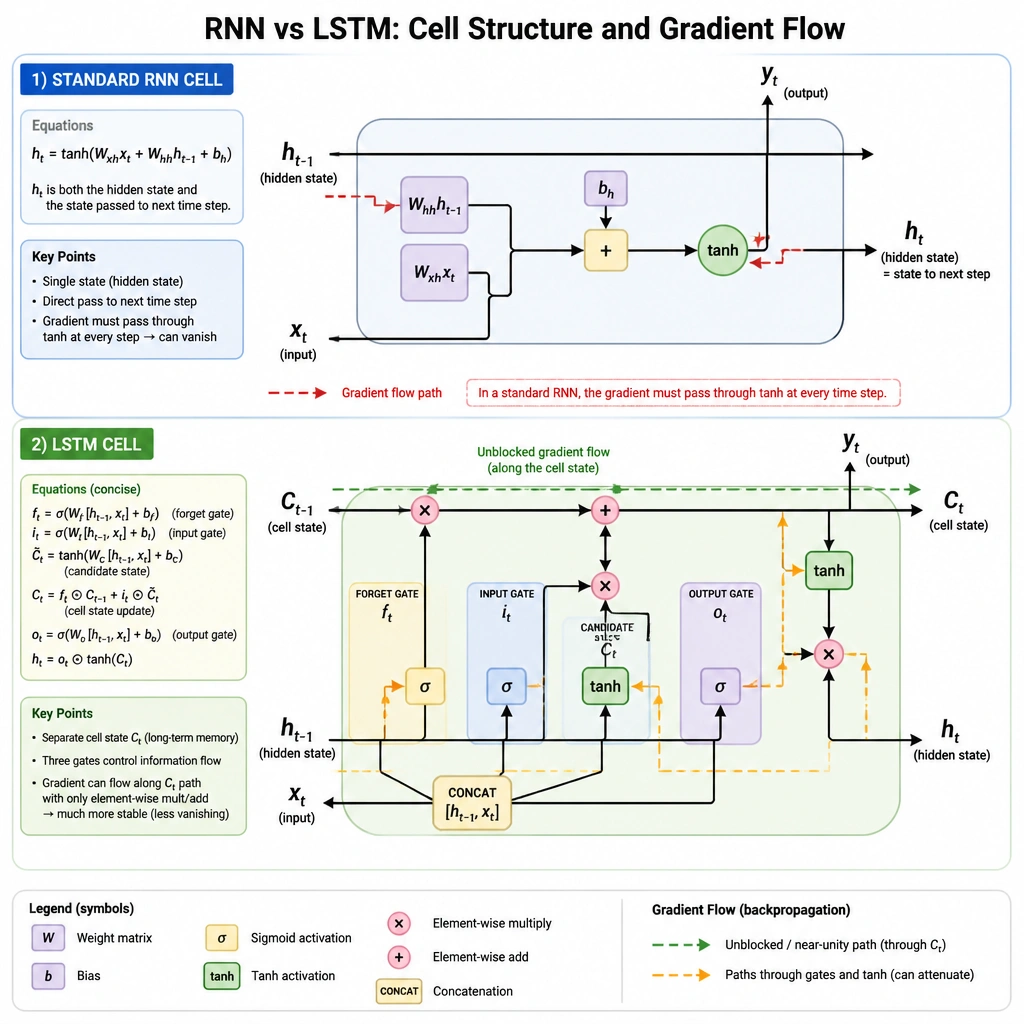
Now here's the deal with standard RNNs: they have a really short memory. When you feed them long sequences, the gradients shrink to zero during backpropagation — we call this the vanishing gradient problem — and the network completely forgets what happened at the start of the sequence. LSTMs are a major upgrade. They use a special "cell state" (think of it like an express highway for information) and three gates — forget, input, and output gates — that decide exactly what info to keep, what to throw away, and what to pass along. This gating mechanism keeps the gradients flowing nicely and lets the network remember things over long steps. Trust me, it's a game-changer for sequence data.
Full explanation below image
Full Explanation
Standard Recurrent Neural Networks (RNNs) suffer from the vanishing gradient problem. When backpropagating through long sequences, the gradients are repeatedly multiplied by weights. If these weights are small, the gradient shrinks exponentially, preventing the network from updating the weights of its earliest layers. Consequently, standard RNNs fail to learn long-term dependencies in sequential data.
Long Short-Term Memory (LSTM) networks solve this issue by introducing a more complex node structure. Instead of a single hidden state, LSTMs utilize a cell state that acts as a continuous memory line running through the steps, along with three interactive gates: 1. Forget Gate: Decides what information from the previous cell state should be discarded. 2. Input Gate: Decides which new information should be stored in the cell state. 3. Output Gate: Controls what information from the current cell state is output as the hidden state.
Mathematically, the cell state allows gradients to flow backward through time with minimal attenuation (addition operations instead of pure multiplications), which directly mitigates the vanishing gradient problem. This allows LSTMs to capture long-term context in text translation, speech recognition, and time-series forecasting.
Let's address the distractors: Option A is incorrect; LSTMs are sequence models, not limited to image data. Option C is wrong because an LSTM is structurally far more complex than a standard RNN, containing multiple internal neural network layers per cell. Option D is incorrect because LSTMs are actually more computationally expensive to train than standard RNNs due to this added complexity and the sequential nature of recurrence that prevents parallel training.