
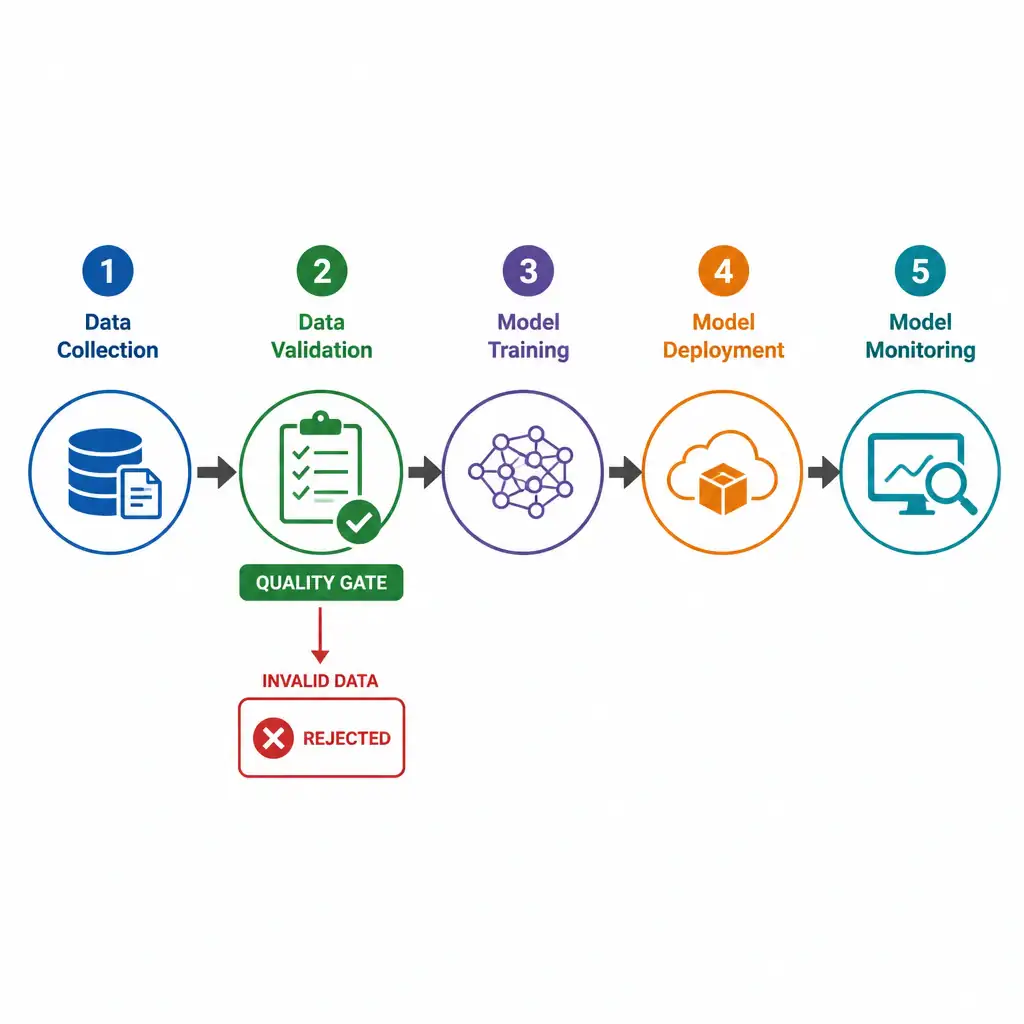
In a production machine learning pipeline, you want to prevent "garbage in, garbage out" issues before kicking off a costly model retraining job. You implement a dedicated data validation step immediately after data collection. What is the primary objective of this step?
Select an answer to reveal the explanation.
Short Explanation
You need to catch bad data before training, because garbage in means garbage out. Data validation checks quality, schema, and consistency so you don't waste money retraining on corrupted data.
Full Explanation
Data validation is a critical phase in the Machine Learning (ML) lifecycle that occurs before model training. The main objective is to detect anomalies, quality issues, or schema changes in the incoming data that could degrade model performance or cause the training pipeline to fail.
A robust data validation step checks for several issues: - Schema conformance: Ensuring the data types, columns, and structures match expectations. - Data completeness: Checking for unexpected null values or missing data. - Data distribution anomalies: Identifying feature drift or covariate shift where the statistical properties of new training data deviate significantly from historical data. - Value constraints: Ensuring numerical features fall within valid ranges (e.g., age cannot be negative).
By catching these issues early, data validation prevents training models on corrupted or biased data, saving computational resources and ensuring the resulting model remains reliable.
Let's address the distractors: The option about updating the weights of the neural network using backpropagation describes model training, not validation. Training uses the validated data to learn features and update network weights, but it is not the validation step itself. The option about packaging the trained model into a Docker container and deploying it to a production cluster refers to serving a finished model to users. The option about continuously monitoring the model's live inference latency and memory utilization in production is a post-deployment step that tracks live model metrics, not the preprocessing of raw training data. Therefore, verifying the quality, schema integrity, and consistency of the dataset before feeding it into the training pipeline is the correct answer.