Before feeding a newly collected dataset into an automated training pipeline, a data engineer runs checks to verify that there are no missing values, schema drifts, or unexpected changes in feature distributions. What phase of the machine learning project lifecycle does this represent, and why is it critical?
Select an answer to reveal the explanation.
Short Explanation and Infographic
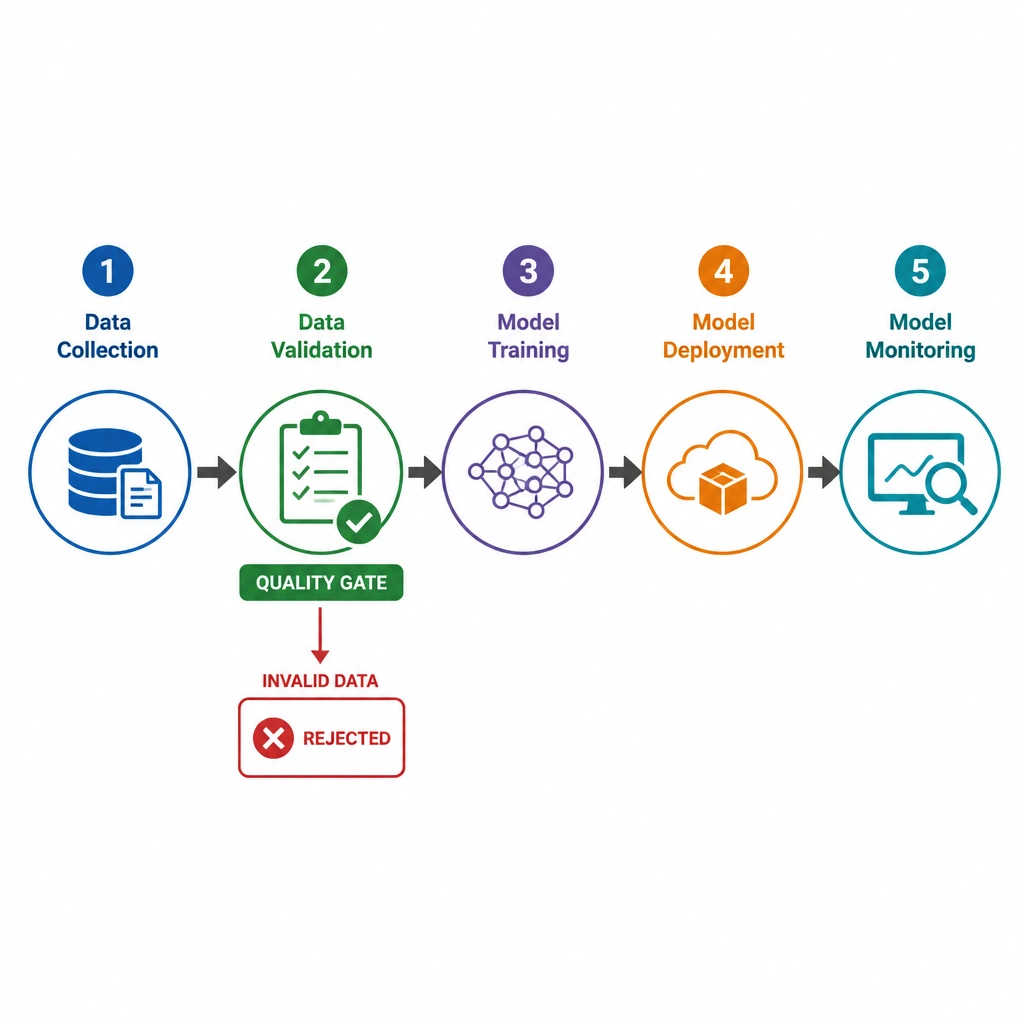
Here's the deal: 'garbage in, garbage out' is the golden rule of machine learning. If you feed your model bad, corrupt, or inconsistent data during training, your model's predictions are going to be useless. That's why data validation is so critical. Think of it like a bouncer at the door of your training club. Before any data gets to touch your model, data validation checks its ID—making sure there are no missing values, no weird columns that don't belong, and that the data types are exactly what we expect. We aren't training the model yet, and we certainly aren't deploying or monitoring it in production. We are just double-checking our ingredients before we start cooking. Trust me, skipping this step is a quick way to cause absolute chaos in your pipelines!
Full explanation below image
Full Explanation
The machine learning lifecycle is comprised of several distinct phases, including data collection, data validation, model training, model evaluation, model deployment, and model monitoring. Data validation is a critical preprocessing step that occurs after data collection but prior to model training. The main objective of data validation is to inspect the quality, integrity, and consistency of the incoming training data. This process ensures that the dataset conforms to a predefined schema (e.g., checking that numerical features contain numbers, dates are formatted correctly, and categorical features have valid values). It also looks for anomalies such as missing data, duplicate records, structural errors, and distribution shifts (schema drift) between the new data and historical baseline data. Performing data validation prevents the 'garbage in, garbage out' phenomenon. If corrupted or drifted data enters the training pipeline, it can cause the training process to fail, result in poor model performance, or lead to silent degradation that is hard to diagnose later. The other stages serve different purposes: Model training is the phase where the model learns patterns from the validated data; Model deployment is the process of integrating a trained model into a production environment to serve predictions; Model monitoring is the ongoing process of observing the model's live performance, latency, and prediction drift after it has been deployed. Thus, checking data consistency and quality prior to training is the core responsibility of the data validation phase.