An e-commerce company wants to implement a system that monitors social media mentions and automatically categorizes each customer post as expressing a positive, negative, or neutral opinion about their brand. Which natural language processing (NLP) technique is designed for this specific classification task?
Select an answer to reveal the explanation.
Short Explanation and Infographic
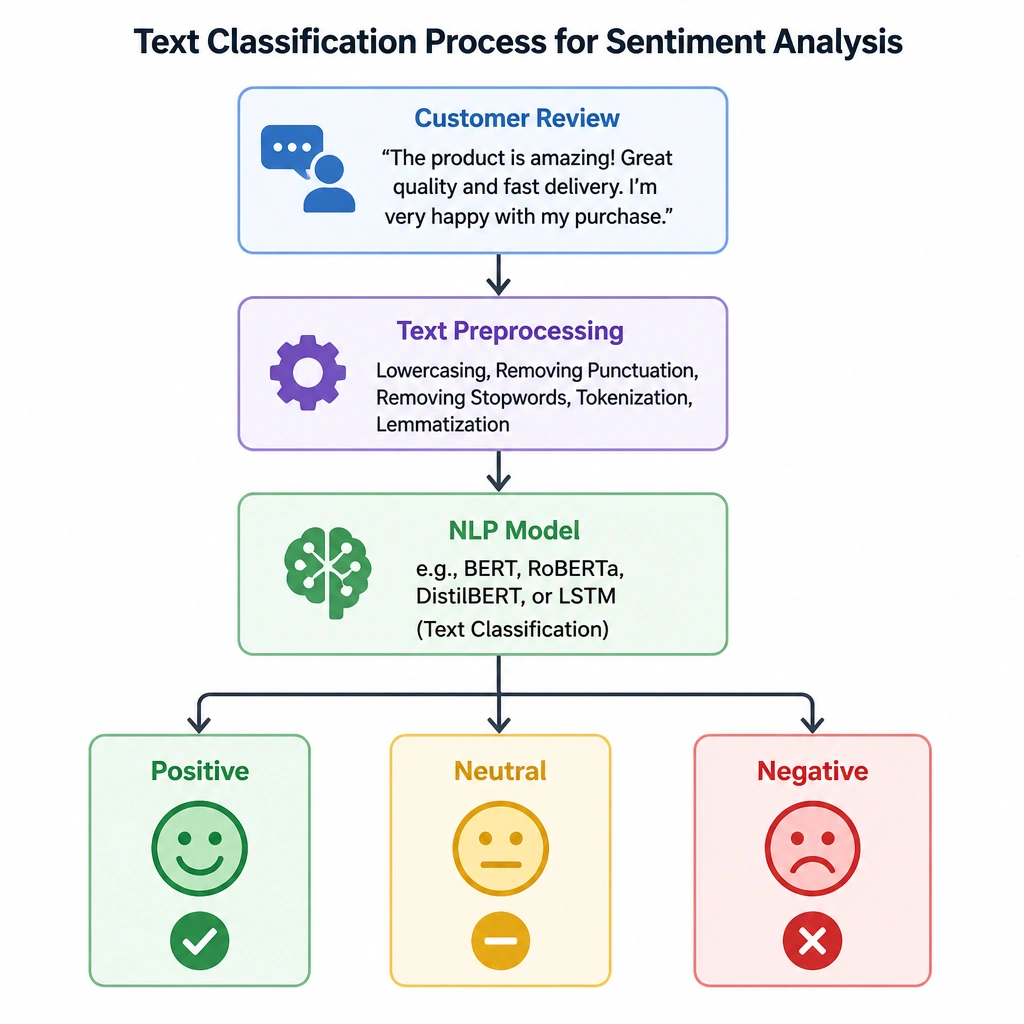
Okay, let's dive in. If you're running a business, you absolutely need to know if your customers are happy or if they're ready to riot on Twitter. But you can't hire a thousand people to read every post. That's where sentiment analysis comes to the rescue. Think of it like a digital mood ring for your text data. It reads a sentence, analyzes the tone, and classifies it as positive, negative, or neutral. This is a classic text classification task under the NLP umbrella. Now, don't confuse this with Named Entity Recognition—NER is just looking for proper nouns like names or locations. And it's definitely not text summarization, which just condenses long articles. If you want to know how people feel about your product, sentiment analysis is the tool you need. Got it? Sweet.
Full explanation below image
Full Explanation
Sentiment analysis, also referred to as opinion mining, is a subfield of natural language processing (NLP) focused on identifying, extracting, and quantifying subjective information from source materials. The primary objective is to determine the underlying emotional tone or attitude expressed in a piece of text—such as whether a customer review, social media post, or support ticket is positive, negative, neutral, or sometimes mixed. Mathematically, sentiment analysis is typically framed as a supervised text classification task. Text data is preprocessed and converted into numerical representations (embeddings) which are then fed into a machine learning classifier, such as a logistic regression model, a support vector machine, or a transformer-based model like BERT. Let's look at why the other options are incorrect: Text summarization focuses on condensing a long document into a shorter version while retaining its core information, rather than classifying its tone; Machine translation involves converting text from one language to another while preserving the original meaning; Named Entity Recognition (NER) is an information extraction technique that identifies and classifies key entities (such as people, organizations, locations, and dates) within a text. While NER can tell you who or what is being discussed, it does not assess the emotional sentiment associated with those entities. Therefore, for a brand looking to categorize customer feedback based on emotional tone, sentiment analysis is the correct and most effective NLP technique.