A machine learning engineering team wants to transition from managing training scripts and model deployments on local development servers to an enterprise-grade pipeline. What is the key advantage of adopting a cloud-based MLOps platform like AWS SageMaker?
Select an answer to reveal the explanation.
Short Explanation and Infographic
Imagine you're running all your ML models on a single local server under your desk. Suddenly, your boss walks in and says, 'We need to train fifty models at once and deploy them to the cloud with auto-scaling.' That local server is going to melt! This is exactly why we use cloud MLOps platforms like AWS SageMaker or Vertex AI. They handle the heavy lifting. We're talking fully managed services, automatic scaling, and seamless integration with your cloud storage and databases. You don't have to spend days provisioning servers or configuring Kubernetes clusters. You just focus on the code and the data, and let the cloud scale up or down as needed. It's a lifesaver for production engineering.
Full explanation below image
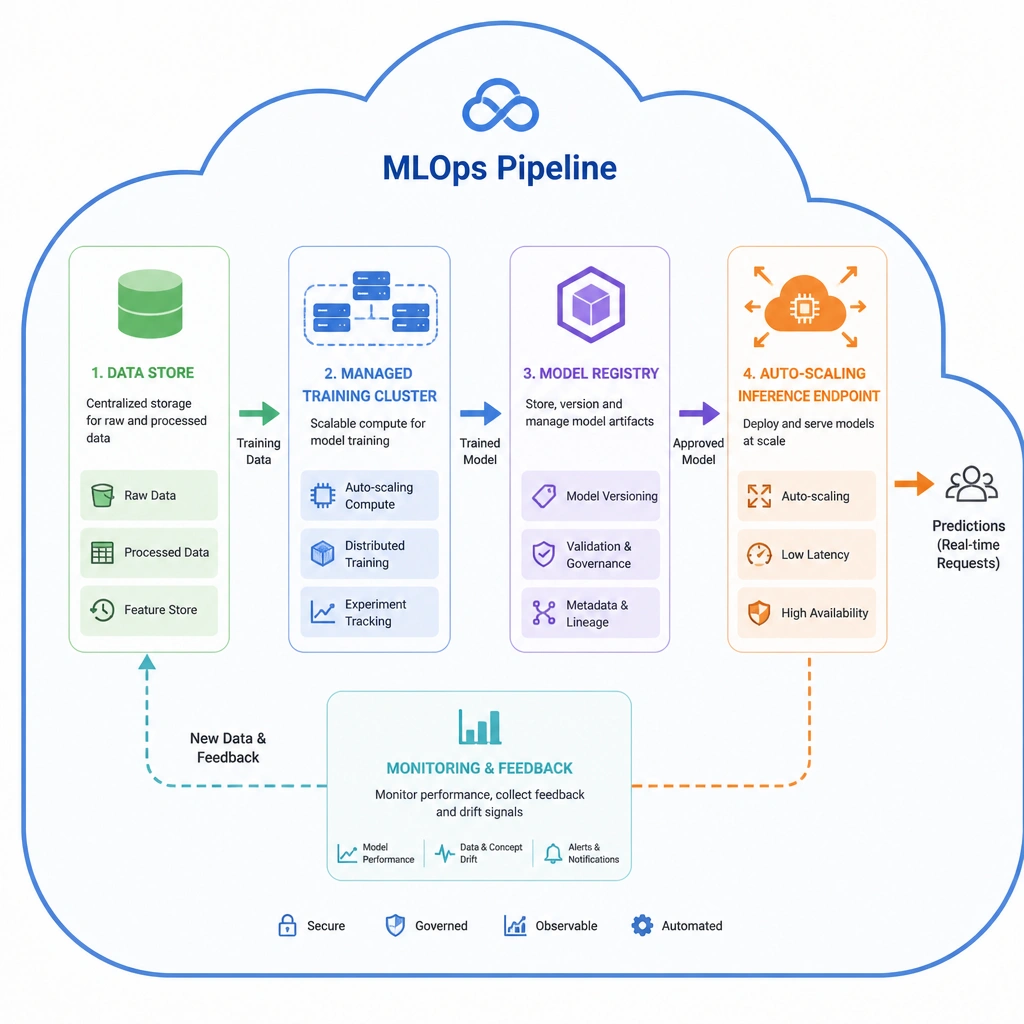
Full Explanation
Cloud-based MLOps platforms (such as AWS SageMaker, Azure ML, and Google Cloud Vertex AI) provide comprehensive suites designed to streamline the machine learning lifecycle. They abstract the complexities of infrastructure management, enabling developers to build, train, and deploy models efficiently. - Option C is correct because the principal benefit of these platforms is the provision of fully managed, scalable infrastructure. This includes automated provisioning of CPU/GPU clusters for training, automated scaling of endpoints for model serving (inference), and native integration with cloud storage, databases, and monitoring services. - Option A is incorrect because these platforms are commercial cloud services billed on a pay-as-you-go basis, not free open-source software. - Option B is incorrect because version control for code is typically handled by specialized tools like Git, whereas MLOps platforms cover the entire ML lifecycle, including training, deployment, and monitoring. - Option D is incorrect because MLOps platforms are specifically designed to distribute training workloads across multi-node clusters and scale endpoints horizontally, rather than restricting operations to a single server.