A development team at a gaming studio wants to build a pipeline that automatically generates highly realistic, non-existent human face textures for background characters. Which neural network architecture is specifically designed for generating high-fidelity, synthetic images using an adversarial training framework?
Select an answer to reveal the explanation.
Short Explanation and Infographic
This is one of the coolest parts of AI. Imagine you want to create highly realistic faces of people who don't even exist. How do you do that? You use a Generative Adversarial Network, or GAN. Think of a GAN like an art counterfeiter and a detective. The Generator (the counterfeiter) tries to create fake paintings, and the Discriminator (the detective) tries to spot the fakes. They go back and forth, training against each other, getting better and better until the generator's fakes look absolutely identical to real photos. It's a brilliant setup. The other options here—like SVMs or Naive Bayes—are classifiers; they just label existing data. And K-Means? That's for clustering. They can't create anything new. Only the GAN has that generative power!
Full explanation below image
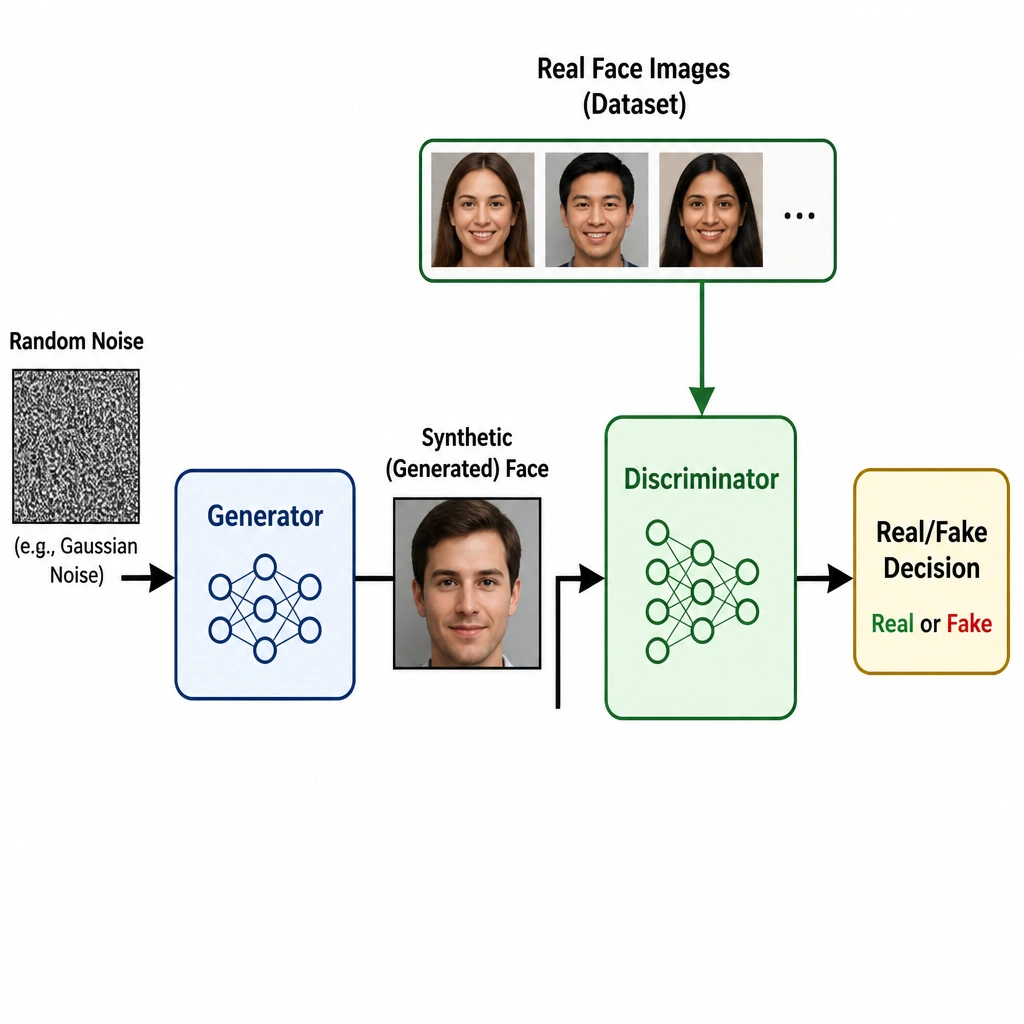
Full Explanation
Generative Adversarial Networks (GANs) are a deep learning framework designed specifically for generative modeling tasks, such as image synthesis. A GAN consists of two neural networks: the Generator, which learns to produce synthetic data samples, and the Discriminator, which learns to distinguish between real samples from the training dataset and synthetic samples from the generator. - Option A (Generative Adversarial Network) is correct because these two models are trained simultaneously in a zero-sum game, forcing the generator to produce highly realistic data to successfully fool the discriminator. - Option B (Support Vector Machine) is incorrect because an SVM is a discriminative classifier that finds a separating hyperplane between classes, incapable of generating new image samples. - Option C (K-Means clustering) is incorrect because K-Means is an unsupervised clustering algorithm designed to group existing data points based on feature similarity. - Option D (Naive Bayes) is incorrect because it is a simple probabilistic classifier based on Bayes' theorem, not a generative model for high-dimensional image synthesis.