
In a production-grade machine learning architecture, what is the primary role of a centralized feature store?
Select an answer to reveal the explanation.
Short Explanation
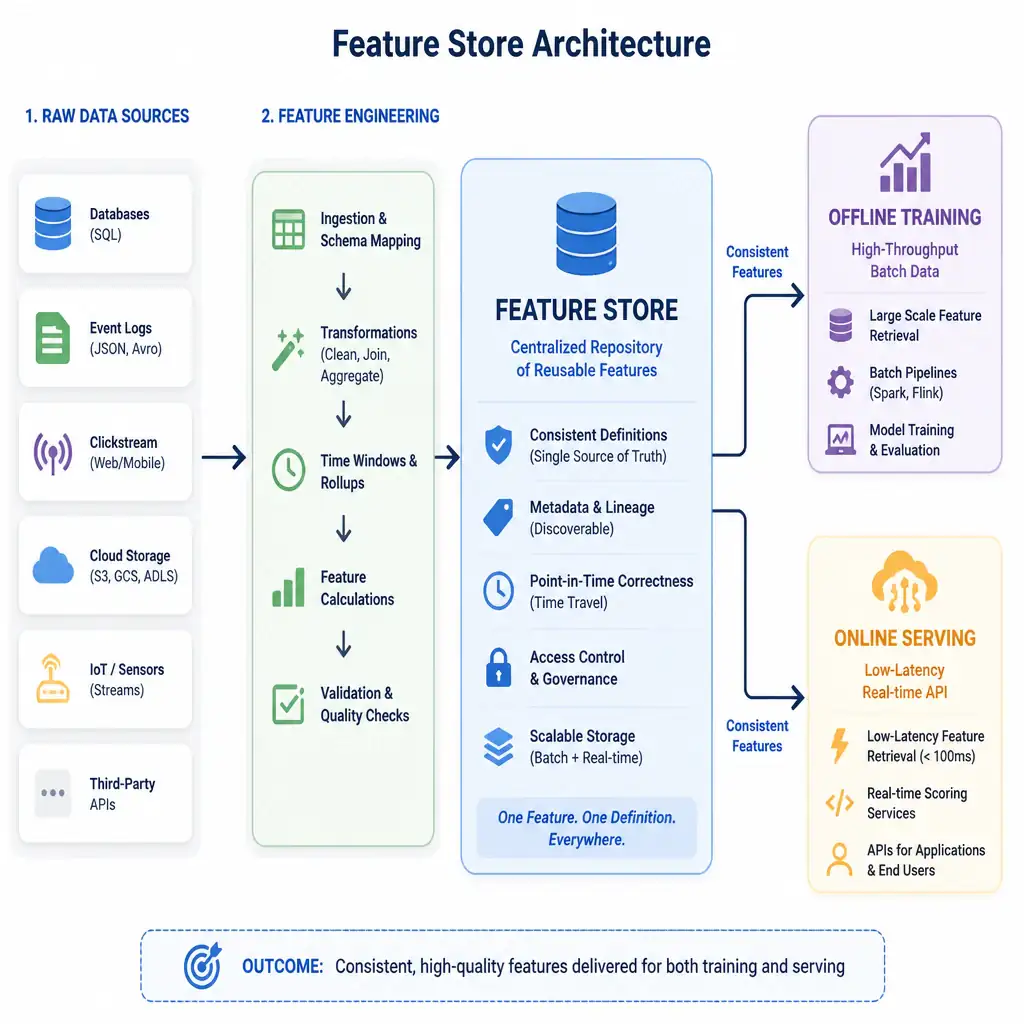
You need a feature store to keep the same clean, processed variables available for both training and live inference. It stops training-serving skew by letting both pipelines pull from one central catalog and serving layer.
Full Explanation
A feature store is a centralized data management system designed specifically for machine learning features. Its primary objective is to solve the 'training-serving skew'—a common issue where the data preprocessing logic used for offline training differs from the logic applied during online real-time inference. By centralizing features, it allows data scientists to register, document, and share engineered features across different models. A feature store maintains a dual-database architecture: an offline store optimized for high-throughput batch queries during model training, and an online store optimized for low-latency, single-record retrievals during live prediction serving. This is why the choice describing cataloging, storing, and serving processed variables consistently for both offline training and online real-time inference is correct.
Let's review the incorrect choices: - The choice about managing version control and code commits for model training scripts is incorrect because code version control is managed by source control repositories (like Git), not data management tools like feature stores. - The choice about monitoring model performance and outputting alerts when predictions degrade is incorrect because monitoring and alerting on prediction quality are the domain of model observability and application performance monitoring (APM) tools. - The choice about storing the trained weights, hyperparameters, and metadata files of completed models is incorrect because storing model weights, hyperparameter logs, and serialized model files is the responsibility of a model registry (e.g., MLflow, Triton, or custom artifact storage), not a feature store.