When training a machine learning model, what is the primary role that the loss function plays in the optimization process?
Select an answer to reveal the explanation.
Short Explanation and Infographic
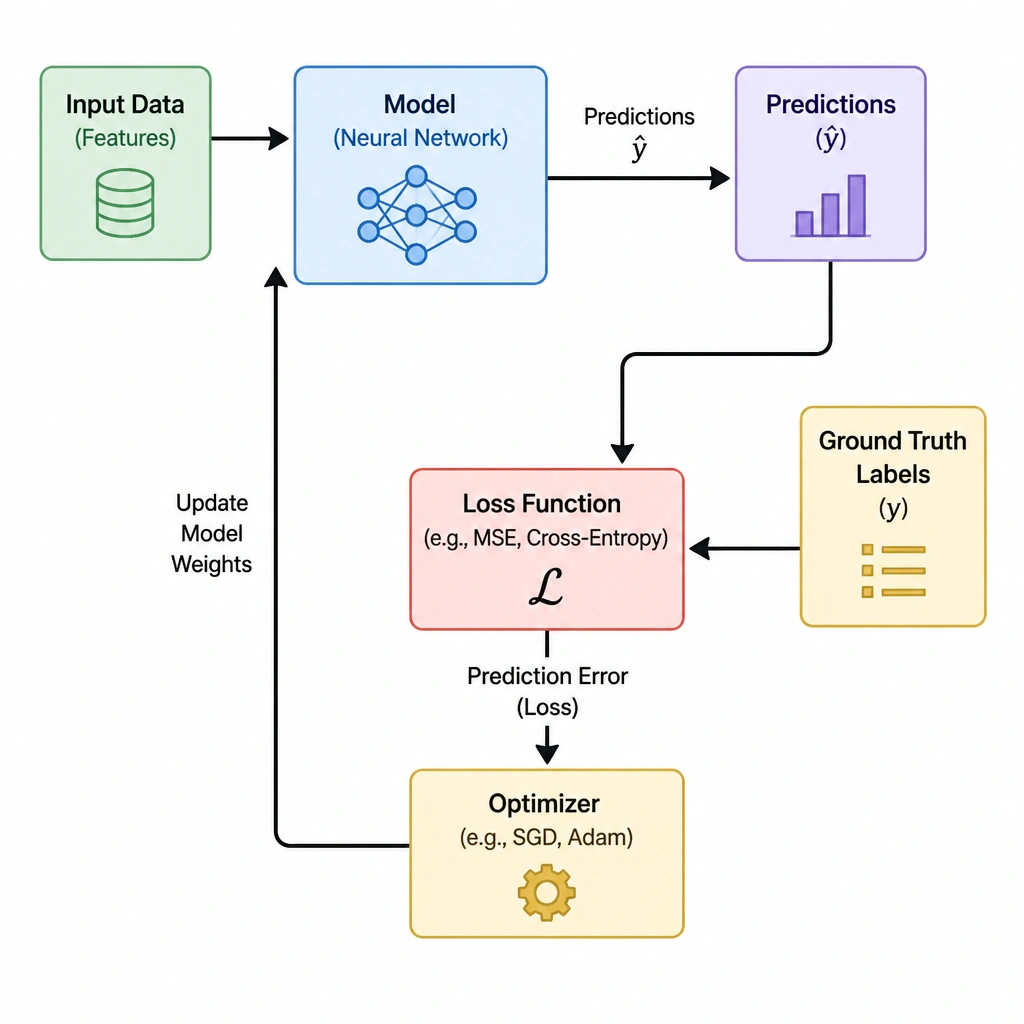
Think of a loss function like the rumble strips on the side of the highway. When you start drifting off course, they make a ton of noise and shake the steering wheel to tell you exactly how far off track you are. In machine learning, the loss function does the exact same thing—it calculates a single number that tells the optimization algorithm how bad its guesses are compared to the actual target data. If you don't know how far off you are, you can't adjust your steering wheel (the model's weights) to get back on track. That's why B is the winner here. Option A is preprocessing, not loss calculation. Option C is about evaluation metrics, which are for us humans to read, not for the optimizer to update weights. And Option D is the job of regularization techniques, not the core loss function. Got it? Sweet, let's keep rolling.
Full explanation below image
Full Explanation
The loss function (also referred to as the cost, objective, or error function) is a mathematical algorithm that serves as the foundation of the optimization process in machine learning model training. During training, the model takes input data, passes it through its layers (forward propagation), and produces a prediction. The loss function then calculates a scalar value that quantifies the discrepancy between this prediction and the ground-truth label.
The optimizer (such as Stochastic Gradient Descent, Adam, or RMSprop) calculates the mathematical gradients of this loss function with respect to the model's parameters (weights and biases). These gradients are backpropagated through the network, determining the exact adjustments needed to minimize the error in subsequent iterations. Without a loss function, the model has no way to evaluate its performance or guide weight updates, rendering optimization impossible.
Let's analyze why the other options are incorrect: - Option A is incorrect because identifying and removing highly correlated features is a feature selection and dimensionality reduction preprocessing step. These tasks are performed before training begins to simplify the input space, rather than during training to guide parameter updates. - Option C is incorrect because evaluation metrics, such as precision, recall, accuracy, and F1-score, are calculated post-hoc to evaluate the model's overall performance for humans. While useful, they are frequently non-differentiable (meaning their mathematical derivatives cannot be computed), making them unsuitable for direct optimization. - Option D is incorrect because preventing overfitting by penalizing complex model structures is the specific job of regularization techniques, such as L1/L2 weight decay or dropout. Although regularization penalties can be appended to the loss function to create a combined objective, the primary purpose of the loss function itself is to quantify prediction error.