You are training a machine learning model to estimate the market value of residential properties based on features such as square footage, number of bedrooms, and geographic location. How is this type of machine learning task classified?
Select an answer to reveal the explanation.
Short Explanation and Infographic
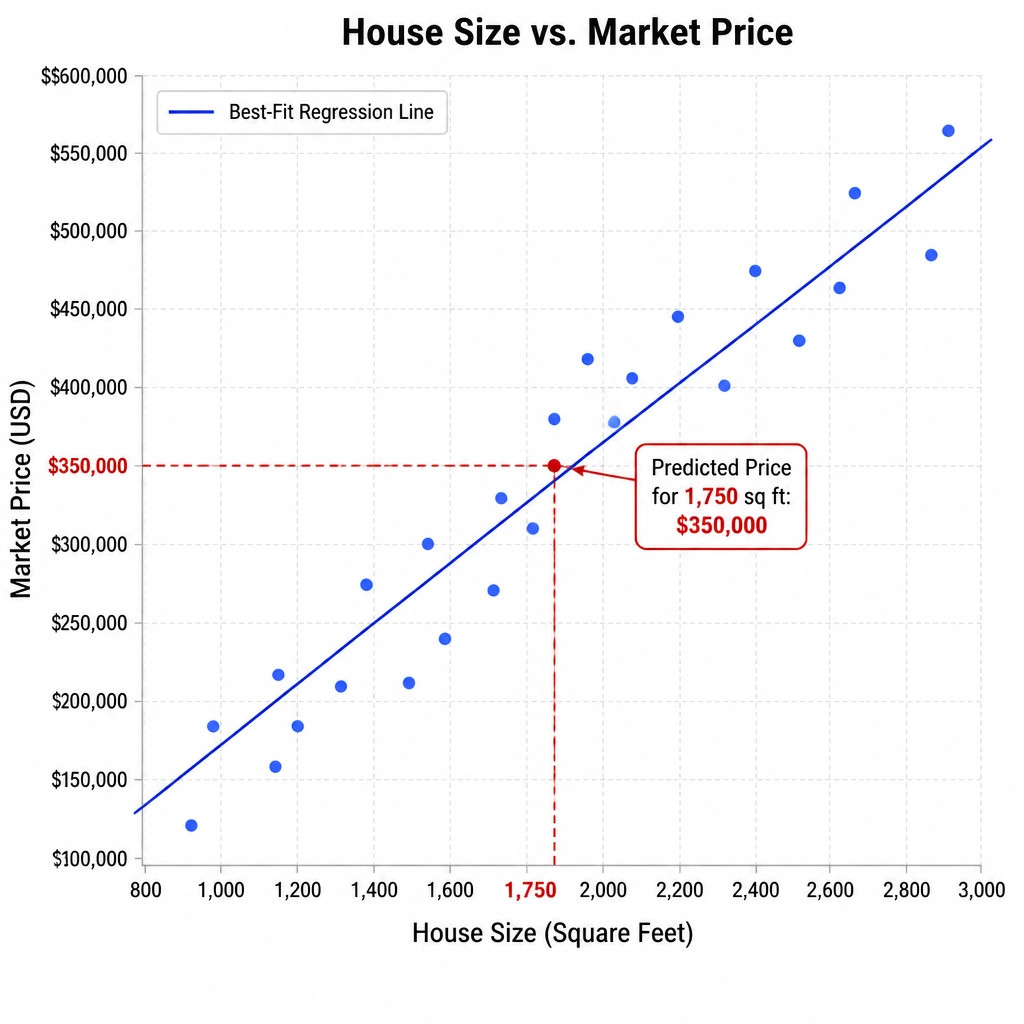
Here's the deal: when you're looking at a machine learning problem, always ask yourself what kind of output you're trying to predict. Are you predicting a label or a category, like "spam" versus "not spam"? That's classification. Or are you trying to predict a continuous numerical value—like a price, temperature, or speed? In this case, we're predicting the market value of a house in dollars. That is a continuous number, which makes it a classic regression task. Think of linear regression or decision tree regressors. Remember, continuous output equals regression. Let's keep rolling!
Full explanation below image
Full Explanation
Supervised machine learning is broadly split into two main task types: regression and classification. Regression is used when the target variable to be predicted is a continuous numeric value (e.g., home prices, temperature, stock prices, or physical measurements). In this scenario, the model uses features (independent variables) like square footage and location to estimate a continuous value (dependent variable) representing the price. Common algorithms for regression include Linear Regression, Support Vector Regression (SVR), Random Forest Regressors, and Gradient Boosting machines.
Let's contrast this with the incorrect options: - Dimensionality reduction (Option A) is an unsupervised learning technique (like PCA or t-SNE) used to reduce the number of input variables under consideration by obtaining a set of principal variables, not for predicting a target value. - Clustering / Grouping (Option C) is an unsupervised task where unlabeled data points are grouped into clusters based on similarity (e.g., customer segmentation), rather than predicting a specific target value. - Classification (Option D) is a supervised task where the target output is a categorical label or discrete class (e.g., predicting whether a house will sell or not, or categorizing a house as 'cheap', 'average', or 'expensive' rather than estimating the exact dollar value).