
An MLOps engineer packages a trained machine learning model and its dependencies into a Docker container. What is the primary advantage of containerizing the model for deployment?
Select an answer to reveal the explanation.
Short Explanation
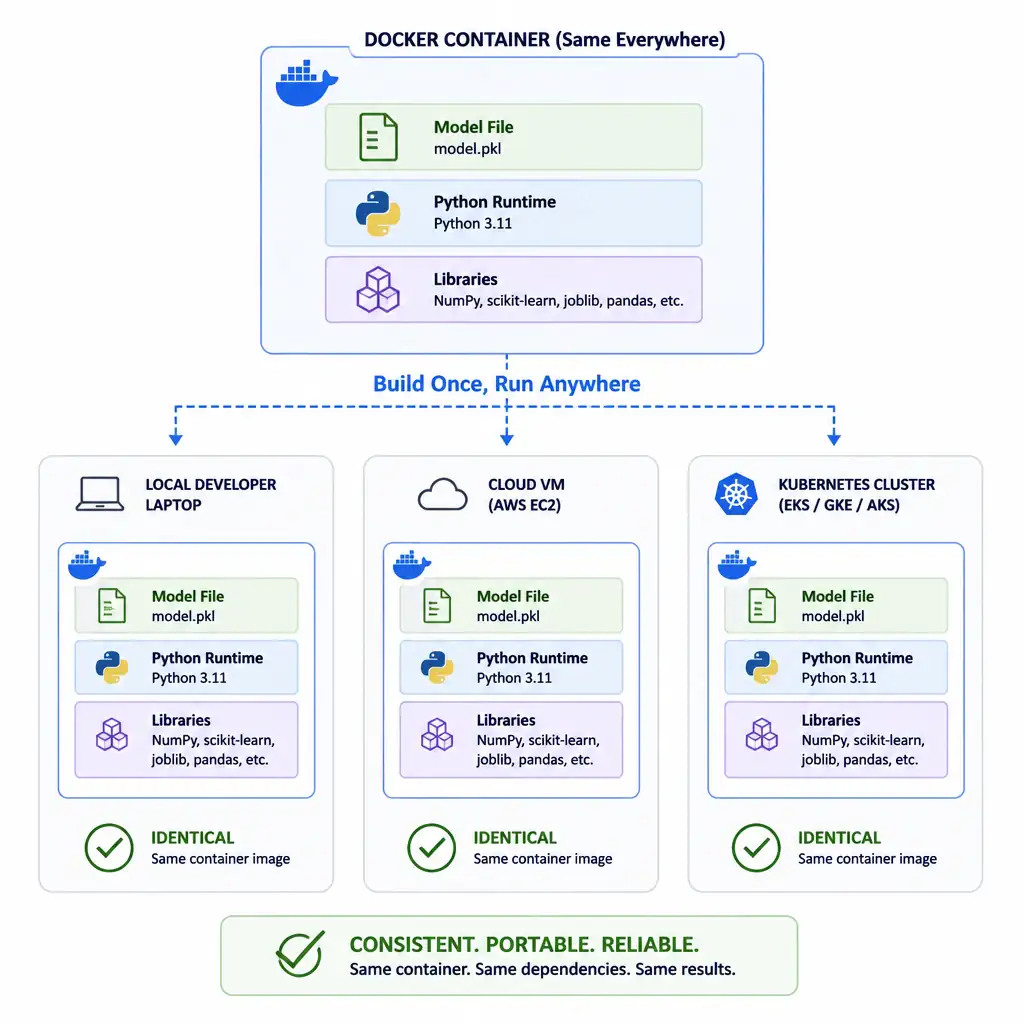
You know the old 'it worked on my machine' mess. Containerizing wraps your model, dependencies, and environment into one isolated package, so it runs the same way from dev to testing to production and doesn't get version conflicts. That consistency is why containers are a cornerstone of MLOps.
Full Explanation
Containerization using tools like Docker involves packaging an application, its dependencies, libraries, binaries, and environment configurations into a single container image. In MLOps (Machine Learning Operations), containerizing models ensures environment reproducibility and isolation. This guarantees that the model will behave identically regardless of whether it is running on a developer's local machine, a staging server, or a highly scaled Kubernetes cluster in production. It prevents the dependency hell scenario where libraries, such as specific versions of CUDA, TensorFlow, or NumPy, conflict with other applications hosted on the same server.
The option saying it automates manual data engineering and feature engineering tasks is wrong because those tasks are handled by workflow orchestrators, such as Airflow, Prefect, or Kubeflow, and continuous integration and continuous delivery pipelines, not the containerization layer itself. The option saying it significantly increases computational speed and reduces the training duration of deep learning models is wrong because Docker is not a training accelerator; it introduces a tiny virtualization overhead, and speed improvements come from optimized hardware such as GPUs or TPUs or from distributed training frameworks. The option saying it compresses the model's weight files to reduce its physical storage size on disk is wrong because compression is accomplished via techniques like quantization, pruning, or model distillation, not by wrapping the application in a Docker container.