During the design of a Convolutional Neural Network (CNN) for image analysis, what is the primary role of a pooling layer (such as Max Pooling)?
Select an answer to reveal the explanation.
Short Explanation and Infographic
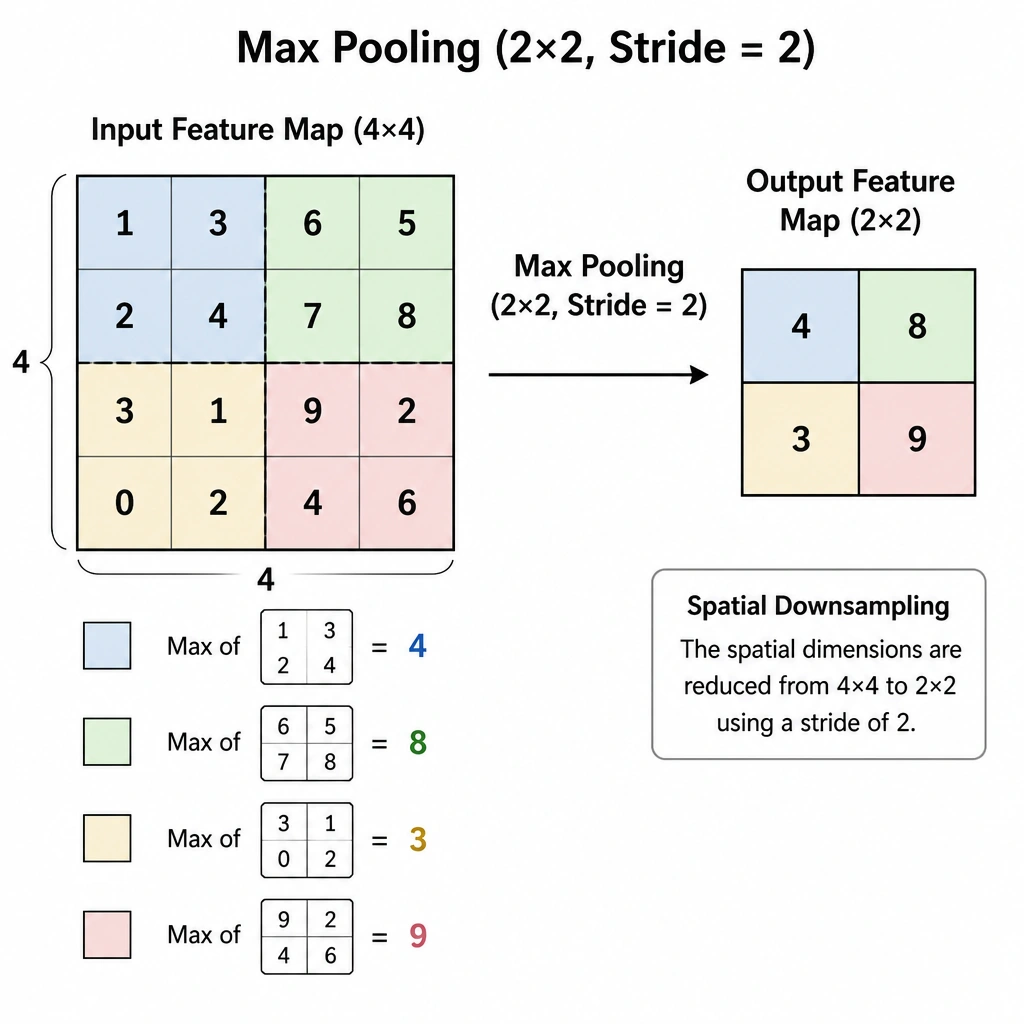
Imagine your boss walks in and says, 'Our image recognition model is taking up too much memory and runs like molasses in production.' If you look at your CNN, you'll see that as images pass through, the feature maps get huge. A pooling layer is your solution to this. Think of it as a smart summarizer. If you use Max Pooling with a 2x2 window, it slides across the feature map, looks at a block of four pixels, and only keeps the single largest value, discarding the other three. This cuts the width and height of your feature map in half! By shrinking the spatial dimensions, you cut down on calculations, save memory, and make the model less sensitive to exactly where a feature is in the image. Option B is what you need.
Full explanation below image
Full Explanation
Pooling layers are fundamental components of Convolutional Neural Networks (CNNs). Their primary function is spatial downsampling (or dimensionality reduction) of the feature maps. The most common type of pooling is Max Pooling, which extracts the maximum value from a specified window (e.g., a 2x2 grid) as it slides across the feature map. By reducing the width and height of the activation maps, pooling layers achieve several critical objectives: they reduce the overall number of parameters and computational cost in subsequent layers, control overfitting, and introduce a degree of translation invariance (meaning the network can still detect a feature even if its position shifts slightly in the image).
Let's analyze the incorrect options: - Option A is incorrect because convolutional layers with multiple filters are used to increase the number of feature channels (depth), not pooling layers. Pooling layers typically preserve the number of channels while reducing spatial dimensions. - Option C is incorrect because while pooling performs a mathematical operation (like taking the maximum or average), it is not where weighted sum calculations or activation functions (like ReLU) are applied. - Option D describes a fully connected (dense) layer, which typically appears at the end of a CNN to map extracted features to class predictions, not a pooling layer.
For the exam, associate pooling layers directly with the reduction of spatial dimensions (width and height) of feature maps.