In a production ML system, low-confidence predictions are routed to human reviewers who verify or correct the outputs. The system then compares these human-verified labels against the model's predictions and feeds the corrected data back into the database. What is the main objective of this workflow step?
Select an answer to reveal the explanation.
Short Explanation and Infographic
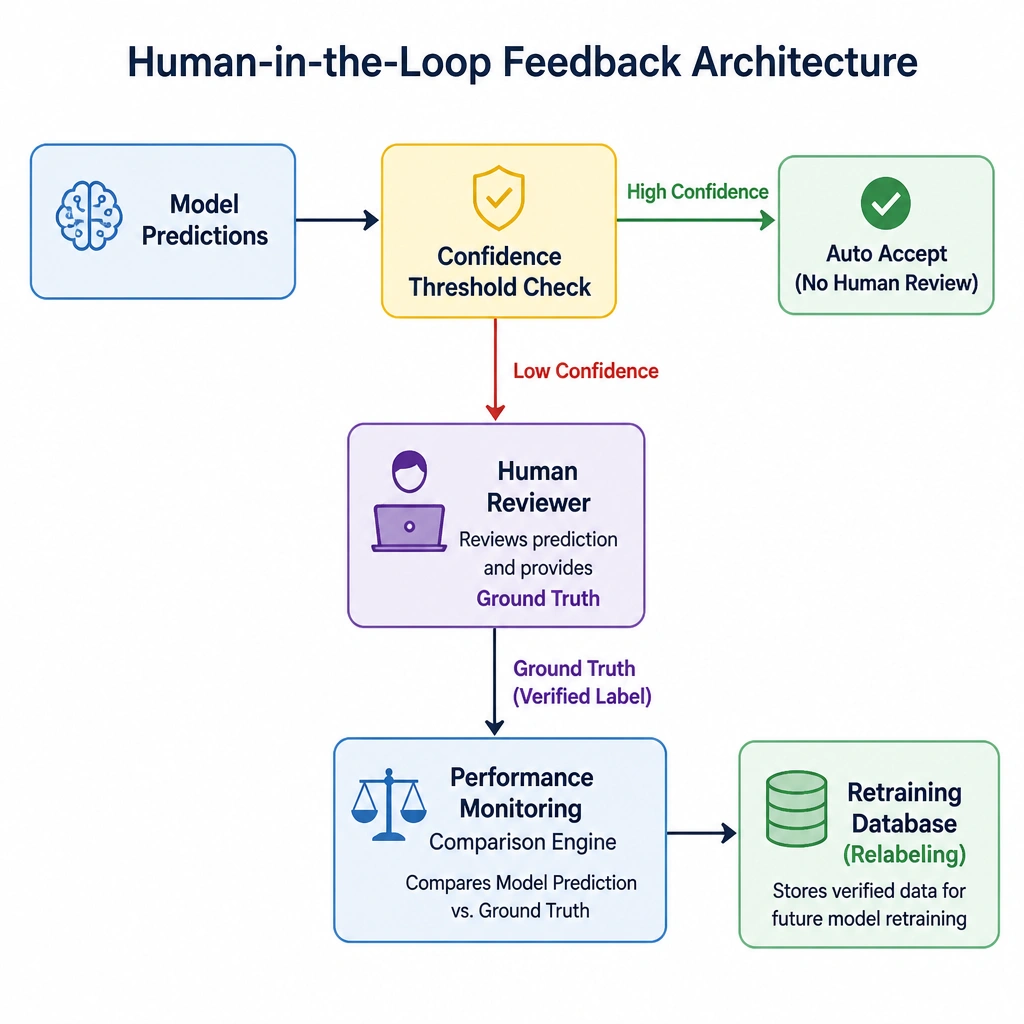
Here's the deal: you can't just deploy a model and assume it's going to stay smart forever. Real-world data changes, and models make mistakes. That's why we use 'human-in-the-loop' systems. When a model isn't sure about a prediction, it flags it and asks a human: 'Hey, is this right?' The human provides the actual ground truth. By comparing what the model thought was right against what the human knows is right, we achieve two major things: we monitor the model's real-time accuracy (continuous monitoring), and we get freshly labeled data to retrain the model and make it smarter (relabeling). It's a continuous loop of learning, and it's absolutely vital for production MLOps.
Full explanation below image
Full Explanation
In production machine learning systems, a Human-in-the-Loop (HITL) workflow integrates human judgment into the active pipeline. When model predictions are compared against ground truth labels provided by human reviewers, the primary purpose is continuous monitoring and relabeling.
This process serves two key MLOps functions: 1. Continuous Monitoring (Validation): By constantly comparing model inferences with human-verified ground truths, organizations can compute real-time performance metrics (e.g., accuracy, precision, F1-score) in production. This allows teams to quickly detect model degradation or concept drift before it causes major business impact. 2. Relabeling and Active Learning: Low-confidence predictions or misclassifications identified by human reviewers are corrected (relabeled). This newly annotated data is stored in a feedback registry and is used to retrain future iterations of the model, refining its accuracy on complex edge cases.
Other choices are incorrect because: - Feature engineering involves selecting, transforming, and creating input variables before model training. - Model deployment is the action of hosting the model on a server to serve API requests. - Data collection refers to the initial gathering of raw, unstructured data from external sources, which occurs prior to modeling and annotation.