When planning a machine learning project, a team must choose between supervised and unsupervised learning approaches. What is the fundamental difference in how these two paradigms utilize data?
Select an answer to reveal the explanation.
Short Explanation and Infographic
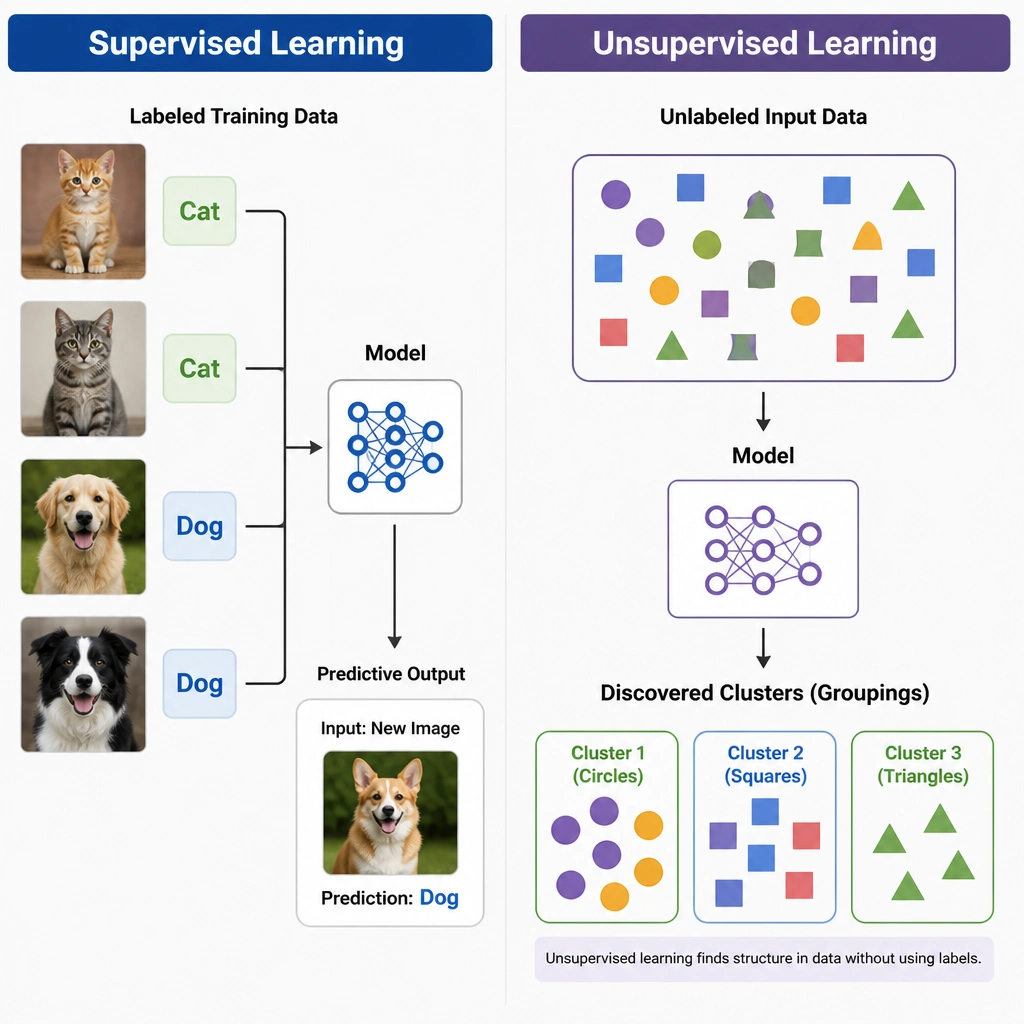
Here's the deal: think of supervised learning like having a teacher standing over your shoulder, correcting your work. The training data has the answers already written in—these are our labels. You feed the model the questions and the answers, and it learns the mapping. Unsupervised learning? No teacher, no labels. The model is on its own to look at a pile of data and figure out what groups together. It's like sorting a big box of random cables by color or type without anyone telling you how. Trust me on this, understanding this difference is absolute bedrock for your exam and your career. Got it? Sweet.
Full explanation below image
Full Explanation
The core distinction between supervised and unsupervised machine learning lies in the structure of the training dataset, specifically the presence or absence of target labels (often referred to as ground truth).
In supervised learning, the training dataset consists of input-output pairs. Each training instance features a set of input characteristics (independent variables) and a corresponding label or target value (dependent variable). The goal of the algorithm is to learn a mapping function that can accurately predict the output label for new, unseen input data. Supervised learning is broadly categorized into classification (predicting discrete class labels, such as spam or not spam) and regression (predicting continuous numerical values, such as housing prices).
In contrast, unsupervised learning deals with datasets that do not contain pre-labeled output targets. The algorithm is given only the input features and is tasked with exploring the data to identify intrinsic structures, relationships, or patterns. Common tasks in unsupervised learning include clustering (grouping similar data points together, such as customer segmentation), dimensionality reduction (simplifying data representation while retaining key information), and association rule learning (identifying relations between variables, such as market basket analysis).
Let's break down why the other options are incorrect: - Option A is incorrect because supervised learning is used for both classification (discrete) and regression (continuous), not just regression. Furthermore, unsupervised learning does not perform classification, as classification by definition requires pre-defined target labels. - Option C is incorrect because unsupervised learning specifically operates on unlabeled data; it does not utilize labeled data or require manual labeling iterations. - Option D is incorrect because it reverses the definitions. Supervised learning requires labeled targets, while unsupervised learning works with unlabeled datasets.