In natural language processing, what is the primary mathematical objective of the Term Frequency-Inverse Document Frequency (TF-IDF) representation model?
Select an answer to reveal the explanation.
Short Explanation and Infographic
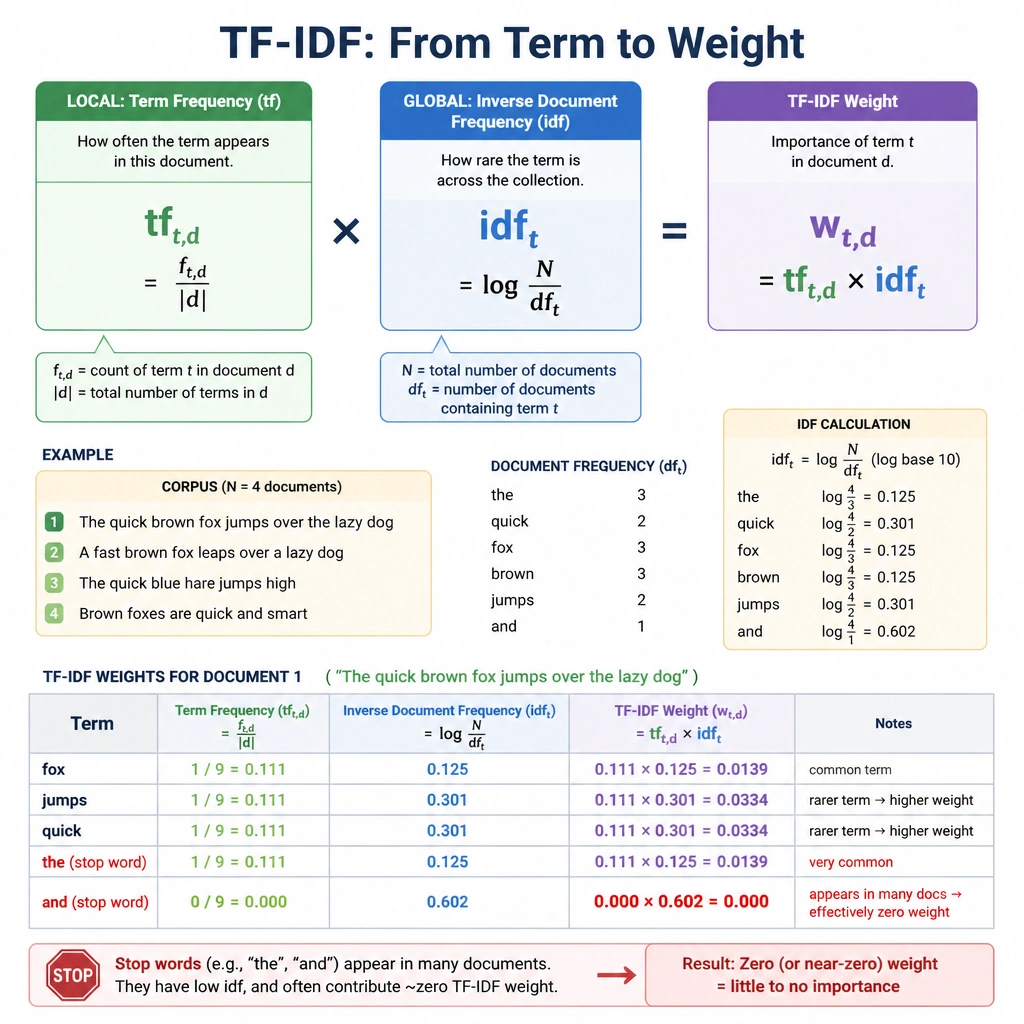
Think of TF-IDF as a searchlight that helps your machine learning model find the most informative words in a mountain of text. If you just count words, the most common ones like "is" and "of" will always win. TF-IDF fixes this by calculating a score for each word. The math is simple: it looks at how often a word appears in a specific document (that's the Term Frequency), and then it multiplies that by a penalty score based on how many other documents also contain that word (that's the Inverse Document Frequency). If a word is everywhere, the penalty is huge and the score drops to zero. If it's rare and only shows up in a few files, its score shoots up. That's why Option B is the right answer.
Full explanation below image
Full Explanation
The mathematical objective of Term Frequency-Inverse Document Frequency (TF-IDF) is to weight terms in a document relative to their informational value. The formula for a term $t$ in a document $d$ within a corpus $D$ is: $$\text{TF-IDF}(t, d, D) = \text{TF}(t, d) \times \text{IDF}(t, D)$$ - $\text{TF}(t, d)$ represents the frequency of term $t$ in document $d$ (often normalized to prevent bias in longer documents). - $\text{IDF}(t, D) = \log\left(\frac{N}{|\{d \in D : t \in d\}|}\right)$, where $N$ is the total number of documents in corpus $D$, and the denominator is the number of documents containing term $t$. If a term appears in every document in the corpus, the ratio $N / |\{d \in D : t \in d\}|$ becomes $1$, and its logarithm becomes $0$, resulting in a TF-IDF score of $0$. This statistical filtering allows classifiers to ignore common stop words and focus on unique keyword features.
Let's review the incorrect options: - Option A describes dense word embeddings (such as Word2Vec or GloVe) which model semantic similarities, not statistical importance scores. - Option C describes One-Hot Encoding, which yields sparse binary vectors without statistical weighting. - Option D describes stemming or lemmatization, which are morphological normalization techniques, not a vectorization scoring method.