A developer is building an application to automatically extract dates, times, and specific currency values from incoming email text. Which Natural Language Processing (NLP) task is most appropriate for this requirement?
Select an answer to reveal the explanation.
Short Explanation and Infographic
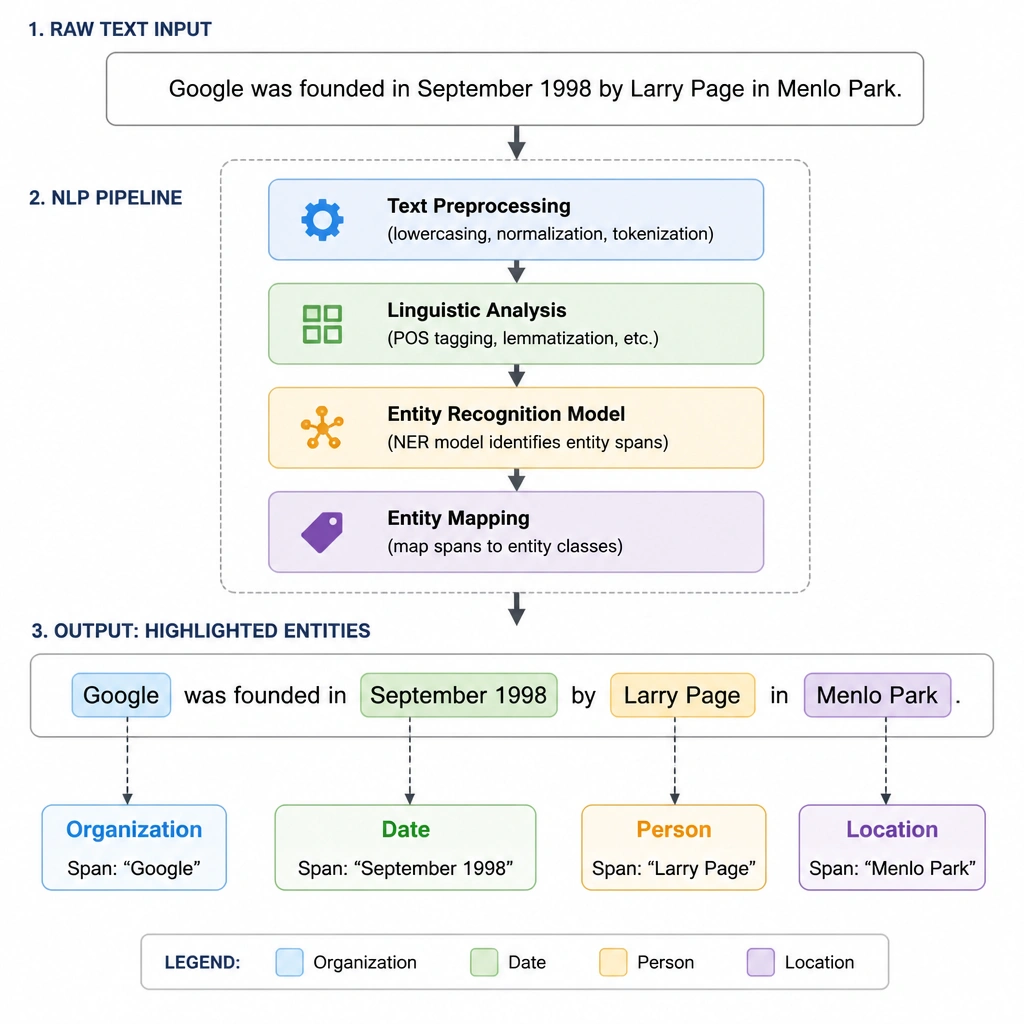
Here's the deal: imagine you've got a giant pile of raw customer support emails and your boss asks you to quickly pull out every customer name, phone number, and location mentioned without opening them one by one. In the real world, you don't want to write a million brittle regular expressions for this. Instead, you use Named Entity Recognition (NER). It's like having a high-tech highlighter that automatically marks the key players in your text—names, dates, places, you name it. The correct choice is B. The others? They're doing completely different jobs on your network.
Full explanation below image
Full Explanation
Named Entity Recognition (NER) is a fundamental subtask of Natural Language Processing (NLP) designed to identify and categorize specific entities within unstructured text. In a typical implementation, NER algorithms classify words or phrases into predefined categories such as names of persons, organizations, locations, monetary values, percentages, dates, and times.
NER works by utilizing sequence labeling algorithms. For example, a modern transformer-based model will assign labels to each token (such as using the BIO tagging scheme: Beginning, Inside, Outside) to mark the boundaries of entities. This is highly useful for downstream tasks such as information extraction, search query optimization, and structured database population from raw documents.
Let's review the incorrect options to understand why they are distractors: - Option A, Sentiment Analysis, is the process of identifying and categorizing opinions or emotions expressed in text (e.g., classifying a review as positive, negative, or neutral), rather than extracting specific datatypes. - Option C, Document Summarization (or Summary of the text), is the process of shortening a document to create a concise representation of its main points, which is a generative or extractive task focusing on global meaning rather than tagging local entity spans. - Option D, Language Modeling, is the foundational task of predicting the probability of a sequence of words or generating the next word in a sequence based on context (as seen in models like GPT).
For the exam, remember that extracting discrete real-world concepts (like people, dates, times, and places) from raw text is the hallmark of Named Entity Recognition.