When implementing an information retrieval system, such as a basic web search engine, how is the TF-IDF algorithm applied to deliver search results?
Select an answer to reveal the explanation.
Short Explanation and Infographic
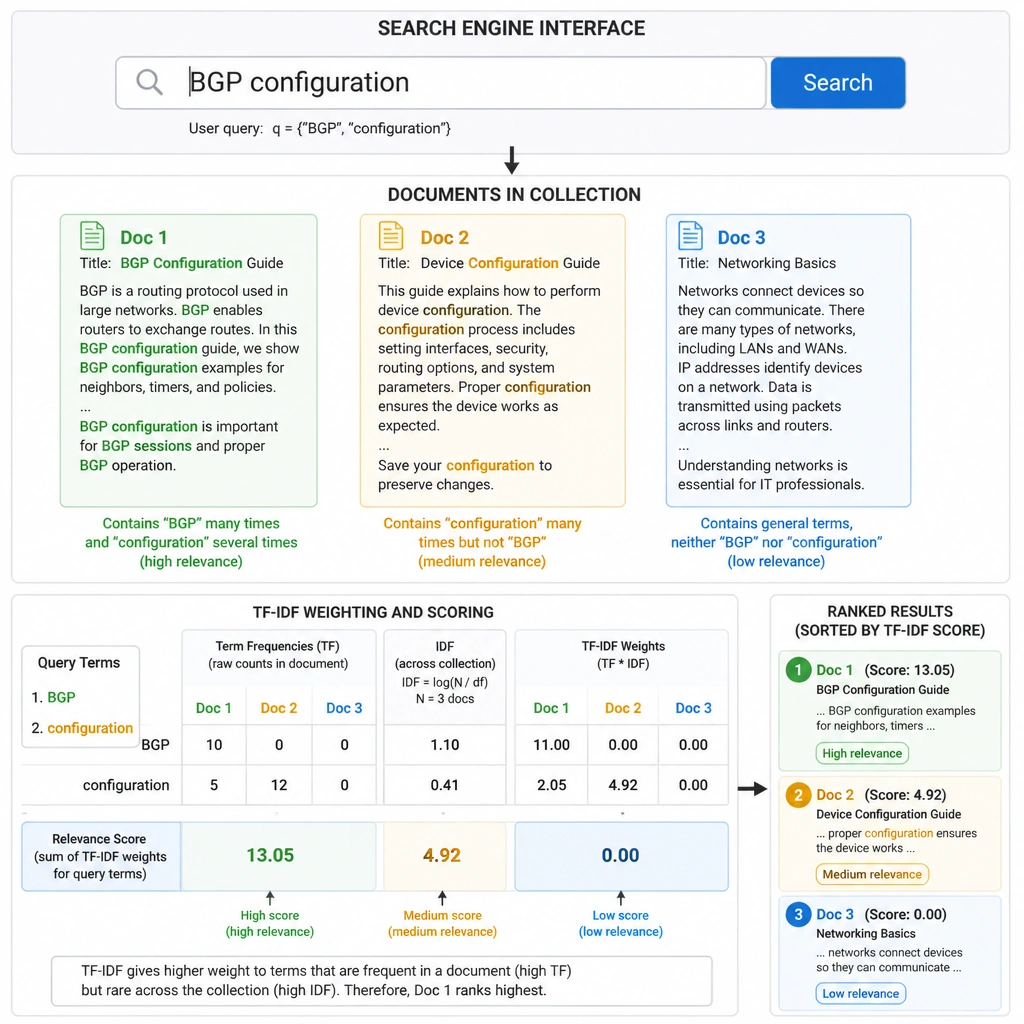
Here's the deal: imagine you're building a search engine for a massive library. If someone searches for "wireless encryption protocols," you need to find the exact books that cover that topic. If your search engine only counted how many times the words "wireless" or "encryption" appeared, it would just return books that repeat those words over and over, even if they aren't actually the most helpful books. TF-IDF fixes this in information retrieval. It weights the search terms so that if a document has a high concentration of the specific words "encryption" and "protocols," and those words are relatively rare across the rest of the library, that document gets pushed straight to the top of the search results. Hopefully you answered A—because TF-IDF is the foundational algorithm for ranking search results by relevance.
Full explanation below image
Full Explanation
In information retrieval (IR), TF-IDF is used to evaluate how well a document matches a user's multi-word query. The goal is to return a ranked list of documents, sorted from most relevant to least relevant.
When a query is submitted, the system calculates a TF-IDF score for each term in the query relative to each document in the collection: 1. Term Frequency (TF): Assumes that a document containing the query term multiple times is more likely to be relevant than a document containing it once. 2. Inverse Document Frequency (IDF): Assumes that rare query terms carry more search intent than common query terms. For example, in the query "how to configure OSPF," the terms "how" and "to" have very low IDF because they appear in almost every document. The term "OSPF" has a high IDF because it is highly technical and rare.
The retrieval system calculates the dot product of the query vector and the document vector (using TF-IDF weights), often normalized using Cosine Similarity. Documents with the highest similarity scores are returned to the user first.
Let's look at why the other options are incorrect: - Option B is incorrect because text classification (sorting documents into categories) is typically handled by classifiers like Naive Bayes, Support Vector Machines, or Neural Networks, although TF-IDF can serve as the input feature representation. - Option C is incorrect because TF-IDF evaluates word-document relationships, not direct physical or structural correlations between documents. - Option D is incorrect because summarizing text requires extractive or abstractive summarization models (like Sequence-to-Sequence models), not a simple statistical retrieval metric.