In the lifecycle of deploying Large Language Models (LLMs), a team decides to utilize "fine-tuning" for their domain-specific application. Which of the following best defines this process?
Select an answer to reveal the explanation.
Short Explanation and Infographic
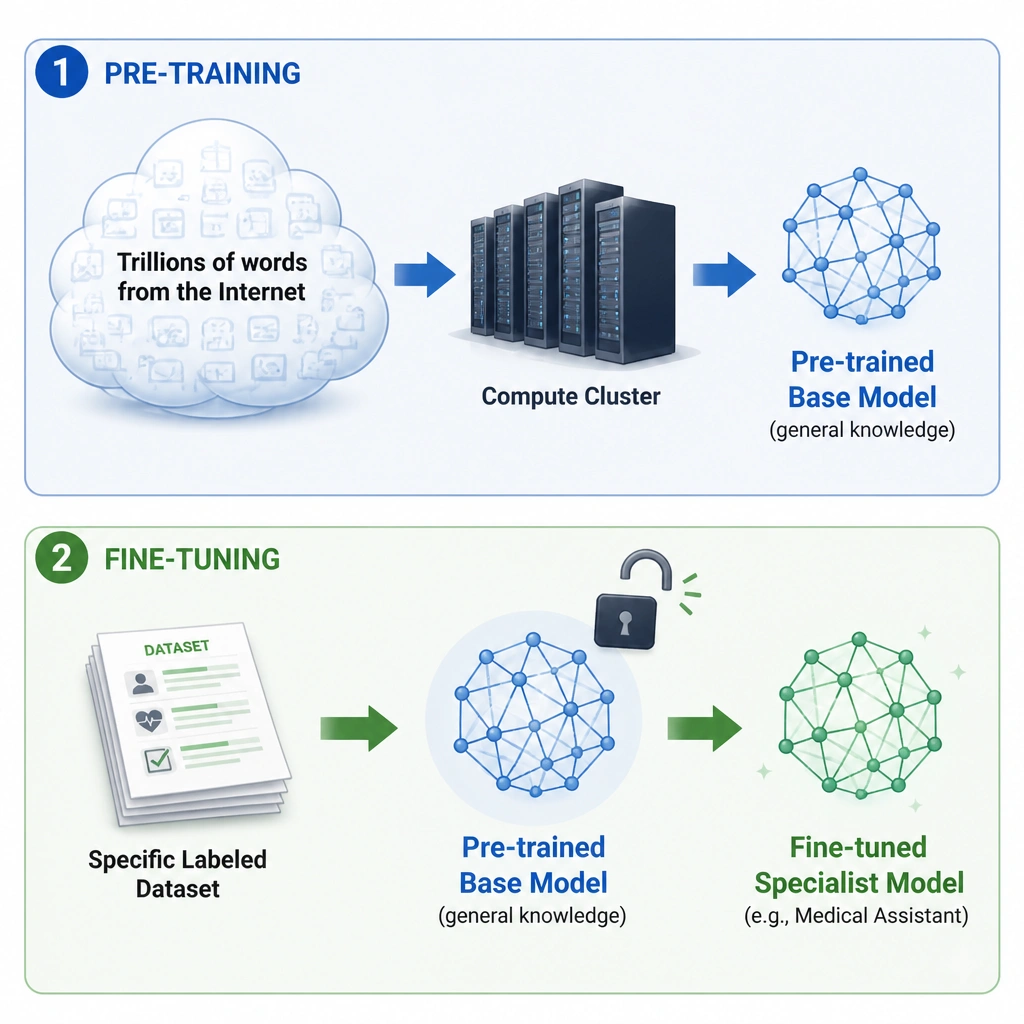
Here's the deal: training a massive language model from scratch requires millions of dollars, thousands of GPUs, and weeks of time. Nobody wants to do that if they can avoid it! Instead, we use a smart shortcut called fine-tuning. Think of it like hiring a college graduate who already knows how to read, write, and speak English (that's your pre-trained model, like GPT or LLaMA). Now, you want them to be a specialized network support engineer. You don't teach them the alphabet all over again—that would be crazy! You just hand them a few Cisco manuals and let them study that specific material. That's fine-tuning. You take a model that already has general knowledge and train it a bit more on a smaller, high-quality, labeled dataset to make it an expert in a specific domain. Hopefully you selected D, because it's the most efficient way to build a specialized AI.
Full explanation below image
Full Explanation
In Large Language Model (LLM) development, fine-tuning is a form of transfer learning. The process begins with a "pre-trained" base model that has been trained on a massive, diverse corpus of web text (often containing trillions of tokens) using self-supervised learning. This pre-training phase allows the model to learn grammar, syntax, reasoning capabilities, and general knowledge about the world.
Fine-tuning adapts this pre-trained model to a specific task (such as sentiment analysis, medical text generation, or coding assistance) by continuing the training process. During fine-tuning, the model's weights are adjusted using a much smaller, curated, and labeled dataset. Because the model already understands language, fine-tuning requires significantly less data and computational time than pre-training, making it accessible for organizations to build high-performing, domain-specific AI models.
Let's look at why the other options are distractors: - Option A describes serialization or compilation (e.g., exporting a PyTorch model to ONNX or TensorRT format) for deployment optimization, not fine-tuning. - Option B describes compression techniques, specifically pruning (removing unimportant connections) and quantization (reducing the precision of numerical values), which are separate optimization processes. - Option C describes the pre-training or training-from-scratch phase, which is extremely expensive and starts with random initial weights.