A software engineer is implementing a sentiment analysis model using a pre-trained BERT architecture instead of training a custom neural network from scratch. Why is fine-tuning a pre-trained model generally more effective than training from scratch?
Select an answer to reveal the explanation.
Short Explanation and Infographic
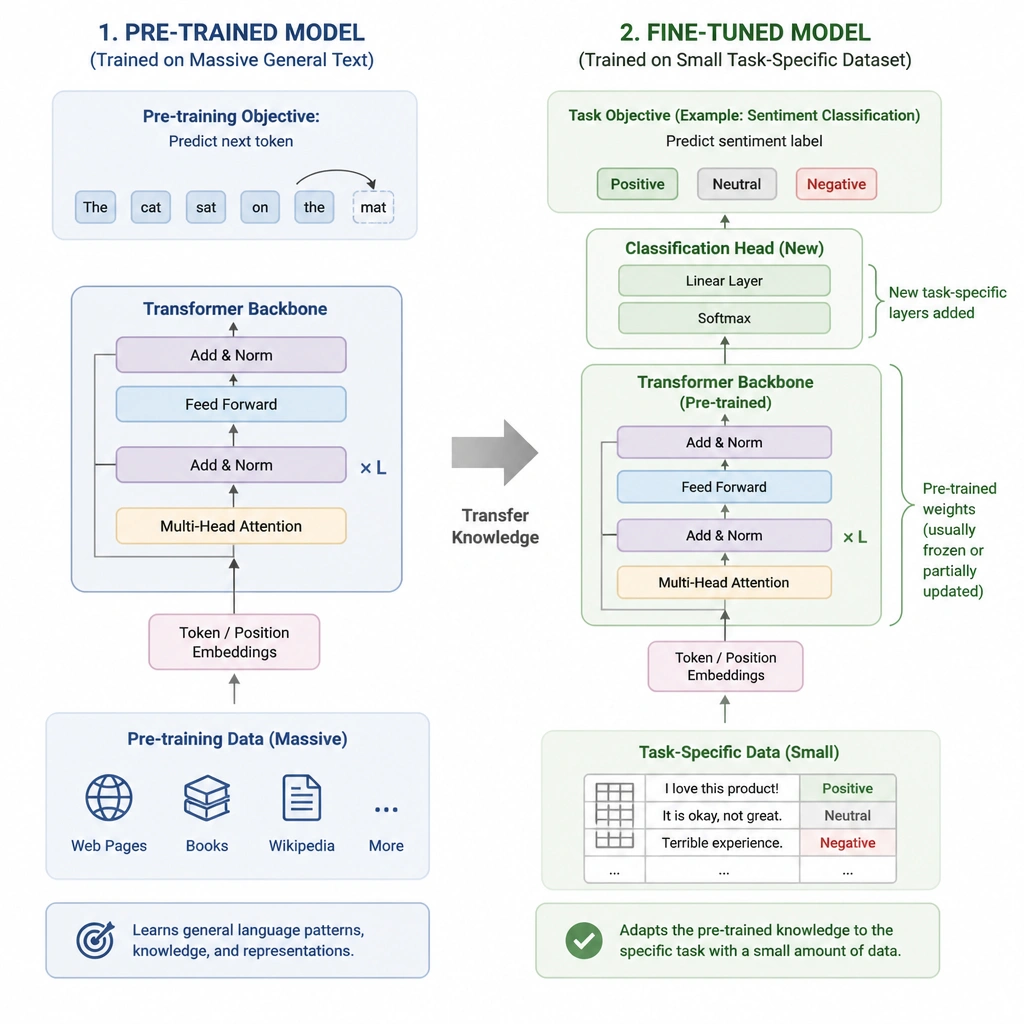
Think of it like this: if you want to teach someone how to configure a complex Cisco firewall, you wouldn't start by teaching them the English alphabet and basic vocabulary first, right? Of course not! You'd hire someone who already speaks fluent English and has basic computer skills, and then you'd train them on the specific CLI commands. That's fine-tuning! A pre-trained model like BERT has already spent millions of dollars' worth of compute learning grammar, context, and vocabulary from massive chunks of the internet. When you fine-tune it, you're just pointing that massive brain at your specific task—like sentiment analysis. It saves you huge amounts of data, time, and money. Trust me, training a giant transformer from scratch is a massive waste of resources unless you have Google-sized budgets. Let's keep rolling!
Full explanation below image
Full Explanation
Transfer learning is the dominant paradigm in modern natural language processing. In this approach, a model is pre-trained on a massive unlabeled text corpus (using self-supervised tasks like masked language modeling) and then fine-tuned on a smaller, labeled dataset for a specific downstream task. - Option B is correct. During pre-training, the model (like BERT) learns general linguistic features, syntax, semantics, and context. Fine-tuning leverages this pre-existing knowledge, allowing the model to adapt to a specific task (such as classification) with far less labeled training data and computational resources. - Option A is incorrect. Fine-tuning actually requires much smaller datasets, not larger ones, because the model does not need to learn language from scratch. - Option C is incorrect. Training a BERT model from scratch is computationally expensive but mathematically possible and is frequently done by organizations with large budgets. - Option D is incorrect. Standard fine-tuning updates all or most of the model's parameters (though typically with a very small learning rate), not just the embedding layer.