You are writing a Python script to train a deep neural network using PyTorch. You have defined your model class and instantiated it. Now, you need to set up the Adam optimizer using torch.optim.Adam. What is the mandatory first argument that you must pass to the optimizer's constructor during initialization?
Select an answer to reveal the explanation.
Short Explanation and Infographic
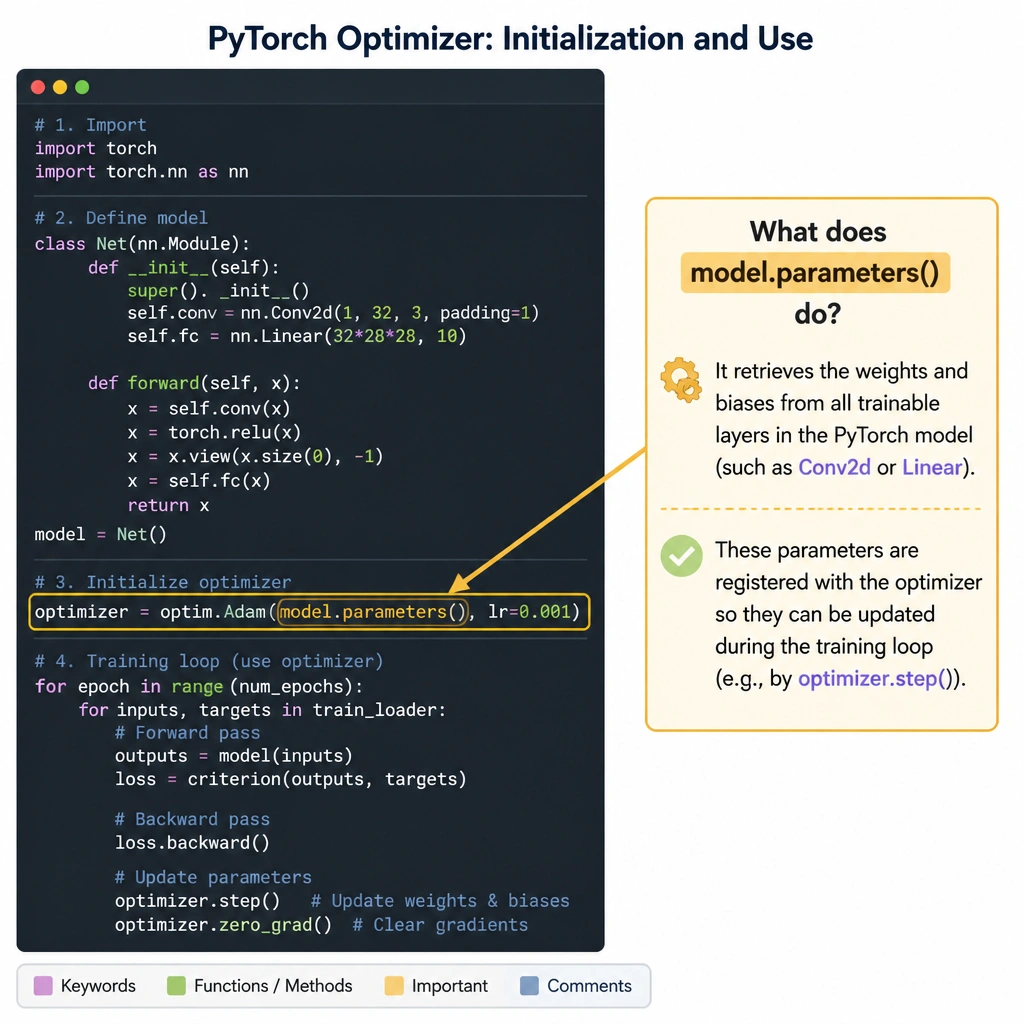
Let's dive into PyTorch! Unlike some high-level APIs that hide the plumbing, PyTorch likes to make sure you know exactly what is going on under the hood. When you build a model and want to optimize it, you have to instantiate an optimizer, like optim.Adam. But think about it: how does the optimizer know which weights and biases it's allowed to modify? You have to tell it! You do this by passing the model's parameters directly into the optimizer when you create it. In PyTorch, you simply call model.parameters() and feed that right in as the first argument. It looks something like optimizer = optim.Adam(model.parameters(), lr=0.001). If you don't give it those parameters, the optimizer has absolutely nothing to optimize, and PyTorch will throw an error before you can even start your loop. Trust me on this, passing model.parameters() is PyTorch 101, and it's a guaranteed test topic. Got it? Sweet.
Full explanation below image
Full Explanation
In PyTorch, the optimization process is highly explicit. To update the weights and biases of a neural network during backpropagation, the optimizer must have direct access to the model's learnable parameters.
When initializing any optimizer from the torch.optim package (e.g., torch.optim.Adam or torch.optim.SGD), the constructor requires an iterable of torch.Tensor objects as its first argument. These tensors represent the weights and biases that the optimizer will modify based on the calculated gradients. For standard models, these parameters are retrieved using the parameters() method of the model instance (which inherits from torch.nn.Module), like so:
``python import torch.optim as optim optimizer = optim.Adam(model.parameters(), lr=0.001) ``
During the training loop, when optimizer.step() is called, the optimizer iterates through these parameters and updates their values using their stored gradient (.grad) attributes.
Let's analyze the incorrect options: - The number of epochs: The number of epochs is a control variable for the outer training loop (e.g., for epoch in range(epochs):). The optimizer itself does not track epochs and does not take this as an initialization argument. - Input data: The optimizer does not interact directly with the raw input data or the data loader during initialization. The input data is passed to the model during the forward pass to produce predictions. - The loss function: The loss function (e.g., criterion = nn.MSELoss()) is initialized independently. It is used during the training loop to calculate the loss value, from which the backward pass (loss.backward()) computes the gradients. The optimizer does not need to know about the loss function directly, only the parameters and their gradients.