A machine learning engineer is comparing optimization techniques to train a regression model. They are deciding between Batch Gradient Descent and Stochastic Gradient Descent (SGD). What is the primary difference in how these two optimization algorithms update the model's weights during training?
Select an answer to reveal the explanation.
Short Explanation and Infographic
Think of it like this: you're trying to clean up a huge yard full of scattered toys. With Batch Gradient Descent, you walk around the entire yard, count every single toy, write down a master plan, and then make one giant adjustment to your cleaning strategy. That's highly accurate, but it takes forever to make a single move, especially if you have a massive yard (dataset)! Now, Stochastic Gradient Descent (SGD) is like picking up one random toy, immediately taking a step towards the toy box, and repeating that process. You're constantly moving and updating your path after looking at just one item. It's noisy and your path will zig-zag all over the yard, but you make progress incredibly fast without waiting to scan the whole yard. In the exam room, remember: SGD updates weights after each individual sample, while Batch GD waits until it has processed the entire dataset before changing a single weight. Got it? Sweet. Let's keep rolling.
Full explanation below image
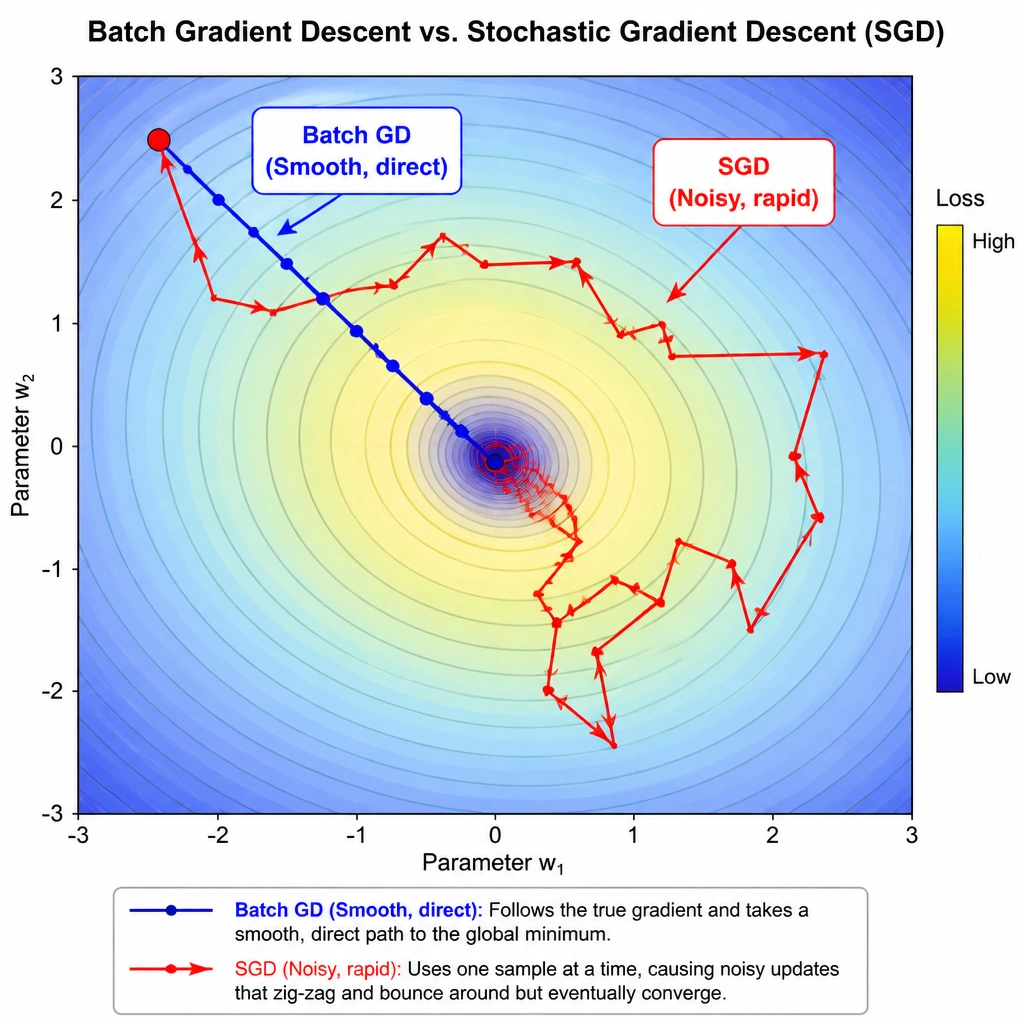
Full Explanation
Gradient descent is an iterative optimization algorithm used to minimize a model's loss function by adjusting its parameters (weights). The primary difference between Batch Gradient Descent and Stochastic Gradient Descent (SGD) lies in the number of training examples used to calculate the gradient before updating the weights.
1. Batch Gradient Descent (Vanilla Gradient Descent): - Mechanism: It computes the gradient of the loss function with respect to the parameters for the entire training dataset. - Weight Updates: The weights are updated only once per epoch (after all training examples have been processed). - Pros/Cons: It produces a stable gradient vector and a smooth convergence path. However, because it requires loading the entire dataset into memory to perform a single update, it is extremely slow and computationally expensive for large datasets, and it can get stuck in local minima or saddle points.
2. Stochastic Gradient Descent (SGD): - Mechanism: It calculates the gradient and updates the model parameters based on a single training example chosen at random. - Weight Updates: The weights are updated continually after every single training example. - Pros/Cons: It is much faster and requires minimal memory, allowing it to handle massive datasets. The frequent, noisy updates introduce variance, which causes the loss to fluctuate. While this noise can prevent stable convergence at the absolute minimum, it also helps the optimizer jump out of shallow local minima.
Let's evaluate the incorrect options: - SGD can only be used with small datasets: In fact, SGD is preferred for large datasets because it doesn't require loading the entire dataset into memory. - SGD is only for deep learning...: Both methods can be applied to any differentiable model, from simple linear regression to deep neural networks. - SGD is faster and more stable: While SGD is faster per iteration, it is much less stable and noisier than Batch Gradient Descent due to the high variance of single-sample updates.